Category Archives: Uncategorized

Tak’s new paper on richness–productivity relationships in a neutral model published in Theoretical Ecology

The relationship between species richness and productivity has been extensively studied in ecology. However, despite decades of empirical and theoretical research, it remains unclear how the relationship changes with the spatial scale of observation. A new theoretical study led by Tak and published in Theoretical Ecology sheds some light on this question by showing how, even in a neutral model, increasing the spatial scale results in non-trivial changes to the richness–productivity relationship.

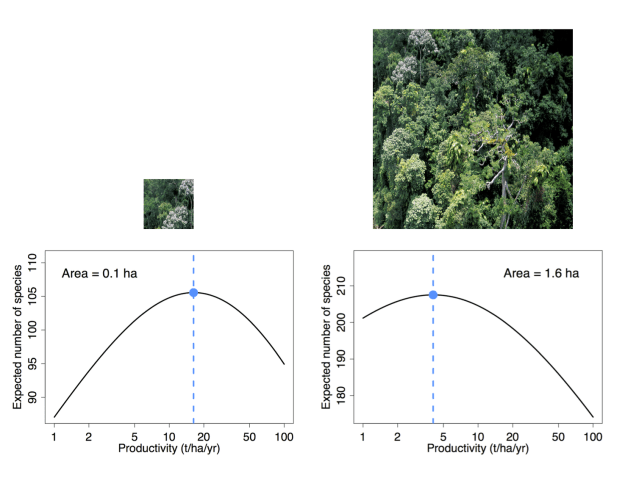
The study analyses a neutral model representing a local community of species populations competing for finite resources. We derived a mathematical formula for the richness–productivity relationship in this model. The resulting curve has a unimodal shape, consistent with previous simulation-based studies. The rising part of the relationship is driven by a sampling effect—more individuals typically comprise a greater number of species (the “more-individuals effect“). The declining part of the relationship is driven by a greater proportion of the pool of propagules being of local origin, which dilutes species diversity arising from immigrant propagules (the “dilution effect“).

Our study’s main novel finding is that the peak of the unimodal richness–productivity relationship from the model shifts to the left as spatial scale increases. The underlying reason is that an increase in spatial scale results in a greater area-to-perimeter ratio, which increases the strength of the dilution effect relative to that of the more-individuals effect. Thus, the increasing phase of the richness–productivity relationship is predicted to be more prominent on smaller spatial scales, while the decreasing phase is predicted to be more prominent on larger scales. These findings can potentially account for some of the observed scale-dependence of richness–productivity relationships in nature.

neutral richness-productivity

Relationship between (expected) species richness and productivity from the model analysed, for a community with area 0.1 ha (left panel) and a community with area 1.6 ha (right panel). The peak of the unimodal relationship shifts to the left as the spatial scale increases. Image credit: CSIRO.

Fung, T., S. Xiao, R. A. Chisholm. Spatial scaling of species richness–productivity relationships for local communities: analytical results from a neutral model. Theoretical Ecology (in press)

UPDATE (June 2020): Tak’s paper has been recommended on Faculty Opinions (formerly F1000).

Tak’s study on partitioning deterministic and stochastic effects on extinction risk published in Ecological Complexity

All species populations are subjected to two broad classes of process: deterministic and stochastic. What are the relative contributions of these processes to the extinction risk of species populations? This is a fundamental question in ecology, and also a practical question for sustainable management and conservation. Some answers to this question are provided in our new theoretical study led by Tak and published in the journal Ecological Complexity.

We used a suite of population models to partition species extinction risk according to deterministic processes and two main types of stochastic process—demographic variance and temporal environmental variance. We found that if the intrinsic growth rate of a species population is moderately or far below zero, then deterministic processes are the dominant driver of species extinction risk, even when the population is small. This contradicts the intuition that demographic variance is always a dominant driver of species extinction risk for small populations. However, if the intrinsic growth rate of a species population is only slightly below zero, then stochastic processes are the dominant driver of species extinction risk, with demographic variance being the main driver for small populations and temporal environmental variance being the main driver for moderate to large populations, consistent with established theory. A surprising finding was that the effects of environmental and demographic variance on extinction times were sub-additive, i.e., the influence of the two combined was substantially less than the sum of their influences in isolation.

Fig_EcolComplex_blog_post

Mean time to extinction for species populations with different initial abundances, under different combinations of deterministic and stochastic processes. In panel (A), the intrinsic growth rate is far below zero, such that deterministic processes are the dominant driver of species extinction risk. In panel (B), the intrinsic growth rate is close to zero, such that stochastic processes are the dominant driver of species extinction risk.

Fung, T., J. P. O’Dwyer, R. A. Chisholm. Partitioning the effects of deterministic and stochastic processes on species extinction risk. Ecological Complexity 38:156–167

New paper in Ecology on habitat configuration and biodiversity in an experimental seawall system

In a new study led by Lynette Loke, of Peter Todd’s lab, we explore the effects of habitat configuration on biodiversity in an experimental seawall system. It is a generally accepted ecological principle that a larger total area of habitat can support greater biodiversity; less certain is the effect of the spatial configuration of this habitat. This question is of general relevance for conservation in today’s increasingly fragmented landscapes. Although there has been much speculation on this topic, there have been few experimental studies at scales incorporating multiple discrete patches. Lynette sought to remedy this with her experimental system of concrete tiles placed on artificial seawalls (pictured below). The tiles can generally support more biodiversity than the unadorned seawalls and therefore constitute “habitat”. Colonising organisms include various species of snail, alga and polychaete worm.

lynette

We found that, as expected, seawalls with more tiles had higher biodiversity—the classic positive species–area result. More intriguingly, we found some evidence that biodiversity peaked at an intermediate level of tile clustering (e.g., middle panel below, where black=tile and white=no tile). We speculated that this could be because the relatively large inter-patch distances in the intermediate configuration make it hard for species to traverse the landscape, leading to greater differentiation in species composition in the separate patches over time.

Screen Shot 2019-05-17 at 11.15.02 am

Effects of habitat area and spatial configuration on biodiversity in an experimental intertidal community. Lynette H. L. Loke, Ryan A. Chisholm, Peter A. Todd. Ecology (in press)

Nadiah’s new paper on a Boolean approach to qualitative network modelling published in Methods in Ecology and Evolution

In a new paper led by Nadiah in Methods in Ecology and Evolution, we tackled an important question for ecological modellers: how do we predict an ecosystem’s behaviour when the data needed to parameterise a model are lacking? For example, managers may be considering different pest-control programmes, which have the potential to lead to positive or negative outcomes for native species. These outcomes can in principle be predicted using dynamical models, but experts rarely have the data needed to parameterise the model, e.g., the interaction strengths for every pair of species. Is there a way to obtain predictions of species responses from the model anyway?

Recently, a suite of techniques known as Qualitative Modelling have become popular because they hold the promise of overcoming common data limitations. However, we showed that current probabilistic versions of these techniques are not robust to equally defensible variations in the sampling method used, leading to the paradoxical result that quite different probabilities can be obtained for the same predicted outcome. Worse, the degree of difference can be large enough to change the management decision that would result. Similar paradoxical results are described by philosophers, arising in simple thought-experiments involving the Principle of Indifference (e.g. Bertrand’s paradox). The paradoxes occur when there isn’t sufficient background information about the problem to specify the parameter space.

To resolve the problem, we adopted a non-probabilistic representation of parameter-value uncertainty: every value of an unknown parameter is simply classified as ‘possible’ or ‘impossible’. We show how Boolean analysis of the resulting possible combinations of positive and negative species responses can be used to summarise the model predictions in a way that is interpretable to conservation decision-makers. Importantly, the predictions obtained in this way subsume the various contradictory predictions obtained from probabilistic approaches, and do not require modellers to implicitly overstate their knowledge about the system by specifying a parameter space and sampling distribution.

See also Nadiah’s longer summary on her blog.

Kristensen, N. P., R. A. Chisholm, E. McDonald‐Madden, 2019. Dealing with high uncertainty in qualitative network models using Boolean analysis. Methods in Ecology and Evolution (in press)

uniques_web1_rabbits_pcus_final_rearrange

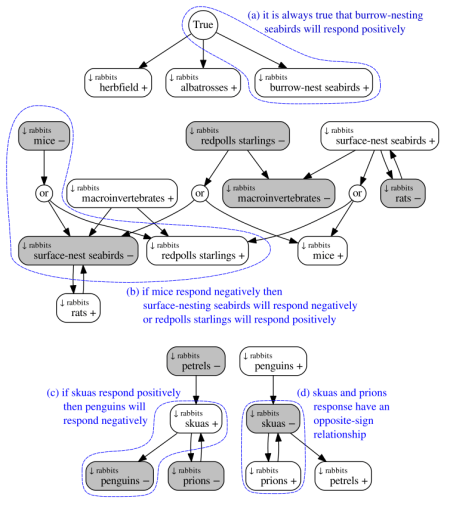
An example result from our new Boolean qualitative modelling approach, analysing the predicted responses of Macquarie Island species to suppression of feral rabbits.


New paper on the top 100 research questions for Southeast Asian biodiversity conservation published in Biological Conservation

In November 2017, Joanna Coleman and Roman Carrasco held a workshop at National University of Singapore, where biodiversity researchers from around Southeast Asia met to discuss top research questions for the future. The outcome of the workshop has now been published in Biological Conservation, in the form of 100 questions that can guide research in the coming years. The questions cover a range of topics, from the drivers of biodiversity loss to the impacts on humans.

Coleman, J., J. S. Ascher, D. Bickford, D. Buchori, A. Cabanban, R. A. Chisholm, K. Y. Chong, P. Christie, G. R. Clements, T. E. E. dela Cruz, W. Dressler, D. P. Edwards, C. M. Francis, D. A. Friess, X. Giam, L. Gibson, D. Huang, A. C. Hughes, Z. Jaafar, A. Jain, L. P. Koh, E. P. Kudavidanage, B. Lee, J. Lee, T. M. Lee, M. Leggett, B. Leimona, M. Linkie, M. Luskin, A. Lynam, E. Meijaard, V. Nijman, A. Olsson, S. Page, P. Parolin, K. S.-H. Peh, M. R. Posa, G. W. Prescott, S. A. Rahman, S. J. Ramchunder, M. Rao, J. Reed, D. R. Richards, E. Slade, R. Steinmetz, P. Y. Tan, D. Taylor, P. A. Todd, S. T. Vo, E. L. Webb, A. Yee, A. D. Ziegler, and L. R. Carrasco. 2019. One hundred top research questions for biodiversity conservation in Southeast Asia. Biological Conservation (in press).

Martin Trappe joins the lab

Martin Trappe has joined the lab as a new Senior Post-doctoral Research Fellow. Martin is a physicist with a background in quantum mechanics and density functional theory. He has worked as a post-doc for the last several years in the Centre for Quantum Technologies at NUS and will continue a 50% appointment there. In our lab, Martin will be working on mathematical models of environmental variance under our Singapore–Israel research grant and looking at applying some theoretical physics techniques to many-body problems in ecology. Welcome, Martin!

Nadav Shnerb visits the lab

Last week Prof. Nadav Shnerb from Bar-Ilan University in Israel visited the lab. This visit was part of a collaboration between our two labs under a recently awarded Singapore–Israel research grant. The purpose of the grant is to allow us to unify and further develop models of ecological community dynamics that incorporate temporal environmental variance. Our two labs have been working independently on these models for the past several years. During Shnerb’s visit last week, we spent many stimulating hours working through mathematics on the whiteboard and engaging in vigorous conceptual discussions. We look forward to a reciprocal visit in the coming year or two.

Tak attends the Ecological Society of America Annual Meeting in New Orleans, USA

Tak attended the Annual Ecological Society of America (ESA) Meeting, held in New Orleans from 5th to 10th August. This is one of the biggest conferences in the field of Ecology, with thousands of attendants.

During the conference, Tak presented new work from our lab on the spatial scaling of relationships between species richness and productivity. The work involves using a neutral community model to make quantitative predictions on how these relationships change with increasing spatial scale. These predictions form a baseline against which to compare results from more complex models. Tak obtained valuable feedback during and after his presentation.

The conference was also a good opportunity for Tak to meet up with colleagues and collaborators. These included Nadav Shnerb from Bar-Ilan University, who is collaborating with us on the effects of temporal environmental variation on patterns of biodiversity in plant communities.

Ernest_N_Morial_Convention_Center.jpg