Category Archives: Uncategorized

Tak’s new paper on probability distributions of extinction times, species richness, and immigration and extinction rates from neutral models published in Journal of Theoretical Biology

Neutral models in ecology make the parsimonious assumption that all species are demographically equivalent, and so their abundances only differ due to demographic stochasticity. Despite neutral models being stochastic models, previous studies have focused mainly on their mean behaviour owing to the lack of formulae for specifying the full probability distributions for biodiversity indicators of interest. In a new paper by Tak, Sonali (former Chisholm lab intern) and Ryan, we use classic results from birth–death processes to derive formulae specifying the probability distributions of extinction times (e.g., see figure below), species richness, and immigration and extinction rates in the classic spatially implicit neutral ecological model.

We demonstrate the utility of our formulae in providing greater ecological insight in a few ways:

1. Firstly, we parameterised a neutral metacommunity model for trees in the Amazon, and used it to show that the age of a common tree species in the Amazon, which by time-symmetry of a neutral model is equivalent to the extinction time of the species, is greater than the oldest estimated age of angiosperms with very high probability. Thus, neutral models produce slow species-abundance dynamics that severely overestimate species age.

2. Secondly, we show how our formula for the probability distribution of species richness can be used to fit a neutral local community model to observed species richness at Barro Colorado Island in Panama, given an independent estimate of the immigration rate. This is more parsimonious than the standard approach of fitting to the full species abundance distribution.

3. Thirdly, we show that the curves of immigration and extinction rates versus species richness in the local community component of the neutral model are for the most part approximately linear, reflecting low variation of species richness around the mean value.


blog_fig

Probability distributions of extinction time for a species population with initial abundance 1 or 2 and per-capita birth and death rates equal to 1/yr, in a neutral metacommunity model with 500 individuals and a per-capita speciation probability of 0.05. The distributions were calculated using the new formula that we derived.

Fung, T., S. Verma, and R. A. Chisholm (2020). Probability distributions of extinction times, species richness, and immigration and extinction rates in neutral ecological models. Journal of Theoretical Biology, 485: 110051. [link: https://www.sciencedirect.com/science/article/pii/S0022519319304205]

Sam’s paper on modelling extinction debt published in Ecology Letters

When natural habitat is cleared, some species go extinct immediately, but others only after a period of time—the latter constitute an “extinction debt”. More habitat loss generally leads to greater species loss and greater extinction debt. But does the spatial pattern of habitat fragmentation matter? This issue is currently the topic of fervent debate in the ecological literature (see, e.g., here and here and here).

In a new Ecology Letters paper led by Sam Thompson, our recently graduated Imperial-NUS PhD student, we developed analytical methods for calculating extinction debt after habitat fragmentation in a spatial neutral model, i.e., a model that treats all species equally. Sam’s paper built on previous work by our lab looking at the immediate response of fragmentation to species richness, i.e., before extinction debt has been paid. Our new methods for estimating extinction debt in a neutral model are accurate and efficient to compute. They involve first calculating two key metrics, termed effective area and effective connectivity, and then plugging these into formulas.

Modelling approaches such as these are invaluable for understanding species loss with habitat fragmentation, because of the difficulty of carrying out large-scale habitat fragmentation experiments. One general insight from our analysis is that for a fragmentation metric to be biologically meaningful, it should be based on the way that the affected species interact with the landscape, rather than on what looks “fragmented” to the human eye.

Overall, we found that even in a neutral model the effect of habitat fragmentation on species loss is non-trivial and varies with spatial scale, temporal scale, and the degree of fragmentation. If this is true even in a neutral model, surely it must be true in reality. We suggest that this degree of subtlety is sometimes missing from the ongoing fragmentation debate, and that any discussion of fragmentation and species richness should be informed by rigorous modelling.

The paper was also coauthored by James Rosindell, Sam’s advisor at Imperial College London.

Update: Our paper has been highlighted on Faculty Opinions.

Thompson, S. E. D., R. A. Chisholm, and J. Rosindell (2019). Characterising extinction debt following habitat fragmentation using neutral theory. Ecology Letters (in press)

extinction_debt

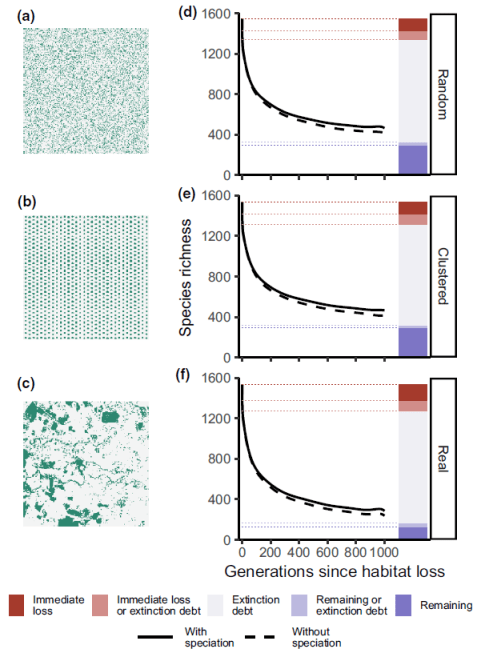
Trajectories of species loss following habitat clearing under different model scenarios for tropical forest trees corresponding to an area of ~5 km2. The shaded grey area to the right of each graph indicates extinction debt in every simulation, with light red and light blue areas additionally indicating the range of extinction debt across all simulations.


Population dynamics and species diversity workshop at Macquarie University

Ryan has just returned from a workshop on population dynamics and species diversity at Macquarie University, Sydney, Australia. The ten participants spent three days brainstorming new approaches to understanding how the dynamics of individual populations aggregate to determine properties of whole communities, including species diversity. As part of this, the participants spent time analysing a global dataset of community and population dynamics compiled from various sources by the workshop leaders, John Alroy and Drew Allen.

Image result for macquarie university site:mq.edu.au

Image credit: mq.edu.au


Payal Dash completes her internship in the lab

Payal Dash recently completed a two-month internship in our lab. Payal is currently pursuing an Integrated Master’s degree at the National Institute of Science Education and Research in India. During her time in the lab, she worked to compile a database of feeding behaviours of the birds of Southeast Asia and spent time learning basic skills in theoretical ecology; in her spare time she visited some of Singapore’s nature-based attractions.

DSC_0047

Visit by Kesara Anamthawat-Jónsson from the University of Iceland

Today the lab was visited by Prof. Kesara Anamhawat-Jónsson from the University of Iceland. Kesara delivered a fascinating talk about plant colonisation of the volcanic island of Surtsey, which lies about 20 km off the coast of the mainland of Iceland and was formed in a volcanic eruption in 1963. We also discussed Surtsey in the context of our lab’s work on island biogeography.

IMG_0577

Chris attends the Hong Kong University International Conference of Undergraduate Research in Science

Chris Wei Ziyi is currently at the Hong Kong University International Conference of Undergraduate Research in Science. This conference brings together undergraduate researchers from around the world to share their ideas and meet professional scientists working at Hong Kong University. Chris presented a poster on his Honours thesis “Population modelling and projected control of invasive Javan Mynas in Singapore”, which led to stimulating discussions with fellow conference participants about urban bird invasions.

WechatIMG3 (1)


Visit to Victoria University of Wellington

Ryan recently visited Victoria University of Wellington in New Zealand, where he met with researchers and delivered a seminar on our lab’s work on estimating rates of species extinctions. The seminar included both our work on historical Singapore extinctions and our work on extinctions due to fragmented habitat loss.

banner_1

An aerial view of the University of Victoria campus (centre of image) with Wellington Harbour in the background. Image credit: http://www.victoria.ac.nz/

Sam has successfully defended his PhD thesis!

Sam successfully defended his PhD thesis this morning at Imperial College London in Silwood Park. Sam’s thesis deals with models of habitat fragmentation and species loss. Being jointly supervised by James Rosindell, of Imperial College, and Ryan, Sam has split his time over the past three and a half years between Imperial College and Singapore. Congratulations, Sam!

IMG-1937

New paper on global patterns of nitrogen-fixing trees published in Journal of Ecology

Our new study, led by Duncan Menge, from Columbia University, and Tak, on global patterns of nitrogen-fixing tree abundance has just been published in Journal of Ecology. Symbiotic nitrogen-fixing (N-fixing) trees can supply large amounts of N to forests, and are important for ecosystem functioning. Patterns of abundance of N-fixing trees have been well studied in the Americas, but less well in other biogeographic regions.

In the new study, which included 82 co-authors from the CTFS-ForestGEO network, we examined patterns and drivers of N-fixing tree abundance in forests across different biogeographic regions. We used tree census data from 44 large CTFS-ForestGEO forest plots, comprising in total approximately 5,000 tree species and 4 million trees. Most of these plots were situated in America and Asia. In America, we confirmed the previously known pattern of a decrease in N-fixing tree abundance by an order of magnitude moving from the tropics towards the poles. In contrast, in Asia, we found no latitudinal gradient in N-fixing tree abundance; instead, abundance was uniformly low, and in particular N-fixing tree abundance in the Asian tropics was approximately six times lower than in the American tropics.

Our results suggest that recent estimates of N fixation rates used in global models may be too high, because they do not account for the Asian tropics having lower N-fixing tree abundance than the American tropics.

Duncan N. L. Menge, Ryan A. Chisholm, … and Tak Fung. Patterns of nitrogen-fixing tree abundance in forests across Asia and America. Journal of Ecology (in press)

Andira_inermis

Trees of the N-fixing species Andira inermis are found in three Panama CTFS-ForestGEO plots used in our study. Image credit: Wikipedia