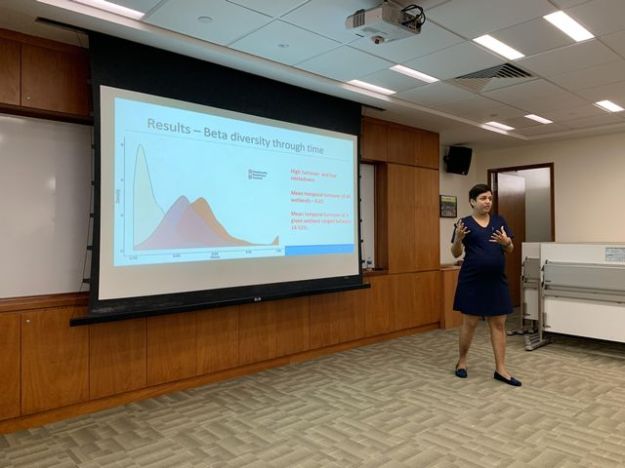
Last week Prof. Nadav Shnerb from Bar-Ilan University in Israel visited the lab. This visit was part of a collaboration between our two labs under a recently awarded Singapore–Israel research grant. The purpose of the grant is to allow us to unify and further develop models of ecological community dynamics that incorporate temporal environmental variance. Our two labs have been working independently on these models for the past several years. During Shnerb’s visit last week, we spent many stimulating hours working through mathematics on the whiteboard and engaging in vigorous conceptual discussions. We look forward to a reciprocal visit in the coming year or two.
Category Archives: Uncategorized
Tak attends the Ecological Society of America Annual Meeting in New Orleans, USA
Tak attended the Annual Ecological Society of America (ESA) Meeting, held in New Orleans from 5th to 10th August. This is one of the biggest conferences in the field of Ecology, with thousands of attendants.
During the conference, Tak presented new work from our lab on the spatial scaling of relationships between species richness and productivity. The work involves using a neutral community model to make quantitative predictions on how these relationships change with increasing spatial scale. These predictions form a baseline against which to compare results from more complex models. Tak obtained valuable feedback during and after his presentation.
The conference was also a good opportunity for Tak to meet up with colleagues and collaborators. These included Nadav Shnerb from Bar-Ilan University, who is collaborating with us on the effects of temporal environmental variation on patterns of biodiversity in plant communities.

Visit to Florian Hartig’s lab in Regensburg, Germany
Ryan recently visited Florian Hartig’s lab in Regensburg, Germany. Florian is a theoretical ecologist whose research interests in community ecology overlap with those of our lab. Florian and Ryan started work on some new collaborative projects, also involving Lisa Hülsmann. Ryan presented a seminar about our lab’s work on island biogeography.

Tak attends the Annual Meeting of the Society for Mathematical Biology in Sydney, Australia
Tak attended The Annual Meeting of the Society for Mathematical Biology & the Japanese Society for Mathematical Biology, which was held from 9 to 12 July at the University of Sydney, Australia (http://conferences.science.unsw.edu.au/SMB2018/).
After acclimatising to the austral winter, Tak presented new work by the Chisholm Lab that uses mathematical models to explain the shape of species–area relationships on islands, and obtained valuable feedback. He also re-united with researchers he had met in previous years, as well as engaging with other researchers: there were interesting conversations on hot topics in theoretical ecology and mathematical biology in general. Furthermore, Tak attended many talks and poster presentations, where he absorbed fresh ideas that could serve as inspiration for his own work.

Sydney University
Association for Tropical Biology and Conservation annual meeting in Kuching, Malaysia
The annual meeting of the Association for Tropical Biology and Conservation came to our part of the world this year: it was held in Kuching, Sarawak, Malaysia from 1 to 5 July. Lahiru, Catharina and Ryan attended. Lahiru presented his recently published work on estimating emissions from peatlands. Catharina presented her ongoing work about altitudinal shifts of frogs on Mount Kinabalu. Ryan presented our recently published work on fragmented species–area relationships. The conference was a great success with 800 attendees from around the world, ample networking opportunities and, in particular, fascinating keynote lectures.

James Rosindell visits the lab
James Rosindell from Imperial College London recently visited the lab for two weeks. James is a theoretical ecologist with an interest in biodiversity patterns and neutral models. James played an instrumental role in our recent paper on fragmented species–area relationships. He is also the joint advisor of Sam Thompson, our Imperial–NUS PhD student. During his visit, James gave a fascinating seminar covering a range of topics from microbial invasion to natural language processing. He also talked about the fractal-based tree-of-life visualisation software developed by his independent non-profit organisation OneZoom.

Nadiah’s new paper on carryover effects has been published in Ecology Letters
What allows a population in a heterogeneous landscape to become locally adapted? In general, adaptation to a rare habitat type is difficult because divergent selection is counteracted by the homogenising effects of gene flow. One well-established condition under which adaptation to a rare habitat type may occur is if the rare habitat has higher quality, so that a greater number of offspring can be produced there, to compensate for the habitat’s relative rarity in the landscape. In our new Ecology Letters paper led by Nadiah, we focus on an alternative way in which a habitat may be considered to have higher quality: by increasing the quality, rather than the quantity, of offspring produced. We show, using simulation models, that such “carryover effects” can indeed permit adaptation to a rare habitat type, counteracting gene flow from a more common but lower-quality habitat type.
We also propose an empirical example of carryover effects: the Blue Tit (Cyanistes caeruleus) on the island of Corsica. Blue Tits utilise two habitat types: deciduous and evergreen. There is evidence that the deciduous habitat is higher quality. On the mainland, the deciduous habitat type is more common, and thus Blue Tits who settle in the rarer evergreen patches are maladapted, resulting in source–sink dynamics. On Corsica, however, evergreen habitat dominates, but the source–sink pattern is not simply reversed. Instead, trait divergence into two ecotypes has been documented. We propose that this is because the deciduous habitat, though rare on Corsica, still has higher quality, and that offspring raised there gain advantages that carry over to their fitness later in life. These carryover effects then explain the observed divergence of the Blue Tit on Corsica into two ecotypes.
Tantalisingly, the carryover effects we study provide a potentially novel ecological mechanism whereby two subpopulations can become isolated. Nadiah gives a more comprehensive summary of the paper on her blog.

The divergence of Blue Tits (Cyanistes caeruleus) on Corsica into two ecotypes may have been driven by carryover effects. Image credit: © Francis C. Franklin / CC-BY-SA-3.0
Lahiru’s new paper on carbon emissions from Southeast Asian peatlands published in Global Change Biology
Peatlands in Southeast Asia have been extensively cleared and drained for agriculture in recent decades, resulting in a source of carbon emissions that is significant on a global scale. In Lahiru’s new paper published in Global Change Biology, he and coauthors have quantified past carbon emissions from these peatlands and estimated future emissions under a variety of scenarios. They estimated historical emissions from 1990–2010 at 1.46–6.43 GtCO2 (0.3–1.2% of global carbon emissions), and projected emissions over the period 2010–2030 at 4.43–11.45 GtCO2.
Of the projected future emissions, 51% are expected to come from areas that have already been cleared for agriculture, as the deep peat soils continue to release their stored carbon. This highlights the need for a focus on sustainable agriculture and peatland restoration as well as conservation of intact peatlands. Another surprising finding was that a high proportion of peatland conversion to agriculture has occurred outside of industrial plantations. In Indonesia, 70% of conversion has occurred outside of government concessions, and 60% of this is attributable to smallholders. This points to a potentially important role for industry in conservation of remaining peatlands.
Lahiru S. Wijedasa, Sean Sloan, Susan E. Page, Gopalasamy R. Clements, Massimo Lupascu & Theodore A. Evans. Carbon emissions from Southeast Asian peatlands will increase despite emission-reduction schemes. Global Change Biology https://doi.org/10.1111/gcb.14340
UPDATE: Nature has published an interview with Lahiru about his peatland research.
Our critique of a global forest analysis has been published in Science
What explains the latitudinal diversity gradient? Why, in particular, are there so many tree species in tropical forests compared to temperate forests? A hypothesis dating back to the 1970s is that if natural enemies, such as insect herbivores and pathogens, are more active in the tropics, then any one tropical tree species will be prevented from becoming too common, and more tree species can thus be packed into a single tropical forest. The control of species’ abundances through such mechanisms is termed “conspecific negative density dependence” (CNDD). Last year, a global forest analysis of 24 sites published by LaManna et al. (2017) in Science claimed to have found evidence in favour of this hypothesis, in the form of stronger CNDD in tropical forests than in temperate forests.
Unfortunately, the analysis by LaManna et al. is flawed, as we show in a Technical Comment published in Science today. Their main mistake was to use an unusual statistical trick, which involved transforming some points in their data set but not others, prior to analysis. More specifically, they split the data at each site into quadrats (of 10 m × 10 m or 20 m × 20 m) and inferred CNDD from the static relationship between saplings and adults of each species across quadrats, and they transformed any quadrat with saplings and no adults by adding +0.1 to the adult abundance. The latter step—the “selective transformation”—affected more data points in tropical than in temperate plots, which ultimately led to a greater bias in CNDD estimates in tropical plots and an artefactual latitudinal gradient in CNDD. LaManna et al. also failed to include an intercept term in their fitted model, even though the data clearly suggest the need for an intercept term, and biologically an intercept term is needed to account for immigration. In our Technical Comment, we explain these mistakes by LaManna et al., perform a more appropriate statistical analysis, with no selective transformation but with an intercept term, on the same data. We find no statistically detectable latitudinal trend in CNDD (see figures below).
Lisa Hülsmann and Florian Hartig from the University of Regensburg have published an accompanying Technical Comment today showing that the methods used by LaManna et al. yield similarly strong patterns even when applied to simulated data sets in which there is no CNDD. This confirms that the patterns observed by LaManna et al. result from biases inherent to their statistical methods rather than any real biological processes. You can read Lisa and Florian’s own blog post on the subject here.
Matteo Detto and Marco Visser of Princeton University are also preparing a paper critiquing the LaManna et al. analysis. They show, consistent with what Hülsmann and Hartig found, that the methods of LaManna et al. produce apparent latitudinal patterns in CNDD even when applied to null models with no CNDD.
The hypothesis that the latitudinal diversity gradient is driven by latitudinal variation in CNDD remains intriguing, but we conclude that the forest data set analysed by LaManna et al. provides no evidence in support of it.
We have uploaded R code and step-by-step instructions here for reproducing our results for the tree species in the Barro Colorado Island forest plot in Panama (Fig. 1 in our paper).

Fig. 1. These graphs show how the model of LaManna et al. (2017) (red) completely distorts the trend in the data (black) for two representative species at the Barro Colorado Island plot. Our model (green) provides a much better fit. These two species are typical. (Reprinted from Fig. 1 in our paper.)

Fig. 2. Our corrected analysis of the global forest data set used by LaManna et al. (2017) reveals that conspecific negative density dependence (CNDD) exhibits no statistically significant relationship to tree species richness (A) or latitude (B) (for comparison with Figs. 1E and 1C in LaManna et al. respectively; reprinted from Fig. 2 in our paper).

Fig. 3. Our corrected analysis also shows no systematic pattern in the relationship of CNDD vs. abundance across latitude. Each line here represents one site, with warmer colours indicating lower latitudes as in Fig. 2D of LaManna et al. (2017). This figure was not included in our paper due to lack of space.
UPDATE: A response by LaManna et al. (2018) was published at the same time as our critique. We did not get to see this response before it was published; if we had seen it, we would have been able to correct several misconceptions.
In their response, LaManna et al. correctly point out that if only the first of the statistical problems we identified is fixed, i.e., if all the data points are transformed instead of just some of them, their overall results remain statistically significant. What they omit to mention is that, under this same scenario, their estimates of median CNDD across species drop from −2.33 to −0.73. In other words, their decision to transform a subset of the data rather than all of the data inflated the magnitude of their main variable of interest by 200%. The inflation is even more extreme for rare species: for the rarest 5% of species, the decision to transform only a subset of the data inflated median CNDD by 600%.
LaManna et al. further claim that our solution to the second statistical problem, which involved adding an intercept to the Ricker model, is not valid, because the Ricker model already has an intercept. We cannot fathom the basis for this claim. The Ricker model is y = x exp(a+bx), which fundamentally does not have an intercept term: the curve always passes through the origin {0,0} (e.g., see Fig. 1A in the response of LaManna et al. (2018)). By “intercept” we simply mean a term that would allow y≠0 when x=0, which in this case would represent immigration leading to saplings in a quadrat (y>0) even when there are no adults present (x=0).
LaManna et al. argue further against our intercept term by claiming that it is confounded with other parameters in the model. Our response is that if two parameters in a model are confounded to some degree, the solution is not to arbitrarily remove one of them and attribute the entirety of the effect to the other. By neglecting to add an intercept term to their model, LaManna et al. produce highly distorted curves that bear little resemblance to the true trends in the actual data (see Fig. 1 above).
LaManna et al. claim that our result of generally weak CNDD “contradicts previous experimental demonstrations of strong CNDD for several tropical and temperate species in our study”. But the experimental studies show simply that CNDD exists, not that it should necessarily manifest itself as a large effect in forest census data.
LaManna et al. also present a new distance-weighted model that produces results that are qualitatively similar to their original results, and they run some new benchmark tests showing our model is supposedly biased, whereas theirs is not. It appears their new model still suffers from the statistical problem of being anchored at the origin, which produces artefacts even if, as in their new model, there are no data at precisely x=0. We will respond in detail to these new claims in a future peer-reviewed publication; we cannot respond immediately because LaManna et al. have not made their full code and data available.
In summary, we stand by our original claims that LaManna et al. (2017) made a series of unusual statistical choices whose effect was to massively inflate the magnitude of their main variable of interest (CNDD), especially for rare species, and distort the trends in the data (Fig. 1 above). These statistical decisions led to the artefactual latitudinal trend in CNDD and other patterns observed by LaManna et al. (2017). In our corrected model the trends disappear (Fig. 2 above). In their revised model (LaManna et al. 2018), they appear to have corrected one problem we identified (the selective transformation) but not the other (the forced zero intercept), and so we suspect their overall results are still artefactual.
References
Sonali completes her internship in the lab
Sonali Verma recently completed a three-month internship in our lab. Prior to this, she graduated with a double master’s degree in Physics, which was divided between France (Université Paris-Sud) and Italy (Università degli studi di Ferrara). She worked on two projects while in our lab. One (shorter) project involved compiling data on small mammals from Victoria in Australia for the lab’s undetected extinction project. The second project, for which she worked with post-doctoral fellow Tak Fung, involved conducting computational simulations of neutral models in R for the lab’s island biogeography project.