Loss of habitat invariably leads to loss of biodiversity, but the effects of habitat fragmentation—the spatial arrangement of habitat patches for a given total amount of habitat—are more contested. In a previous experiment in intertidal environments led by Lynette Loke, now of the University of Melbourne, we found that animal species richness peaked at intermediate fragmentation. In a new paper, led by Lynette again and just published in Landscape Ecology, we dug deeper into the mechanisms generating this pattern.
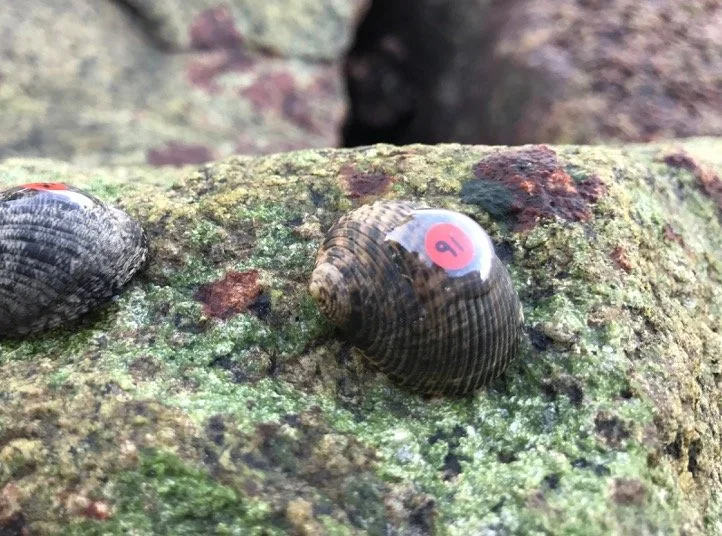
We theorised that the higher diversity of intertidal animals in the intermediate fragmentation treatment could arise because the inter-patch distances are highest in this treatment (middle panel below), which could lead to greater dispersal limitation and higher turnover between patches. In the new study, we tested this by tracking gastropods over 45 days and measuring how far they moved in the different treatments. As hypothesised, the gastropods moved least in the intermediate-fragmentation treatment (although the difference was statistically significant only for the comparison with the low-fragmentation treatment). The results lend support to our theory that dispersal limitation can lead to maximum diversity at intermediate fragmentation.
Loke, L.H.L., Yeo, H.H.J., Chisholm, R.A., Theng, M. Intermediate habitat fragmentation reduces gastropod movement in experimental intertidal landscapes: implications for fragmentation–diversity relationships. Landscape Ecology. 2026. https://doi.org/10.1007/s10980-026-02441-9