Category Archives: Uncategorized

Four undergraduates join the lab for summer internships

Image
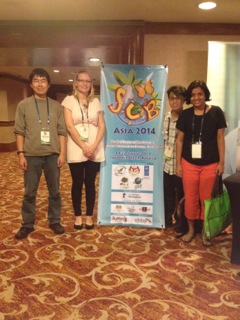
Left to right: Laura Villain, Yang Jia Qi, Aden Ip Yin Cheong, Soh Yong Sheng

Summer internships in our lab give undergraduate students the opportunity to learn skills and techniques used in theoretical ecology and to collaborate on exciting research projects. This summer we have four interns:

  • Jia Qi is majoring in biological sciences at NUS. For her internship, she is working with Aden to investigate the relationship of invasive species richness to native species richness and economic development for countries around the world.
  • Aden is also majoring in biological sciences at NUS. He is working with Jia Qi on the invasive species project.
  • Laura is an exchange student from INSA Lyon in France, where she is studying bioinformatics and mathematics. For her internship, she is developing mathematical models to estimate species dominance in ecological communities.
  • Yong Sheng is majoring in physics and minoring in computer science at NUS. For his internship, he is analysing mathematical models of the relationship between biodiversity and ecosystem function in forests.

New CTFS paper on temporal variability of forest tree communities published in Ecology Letters

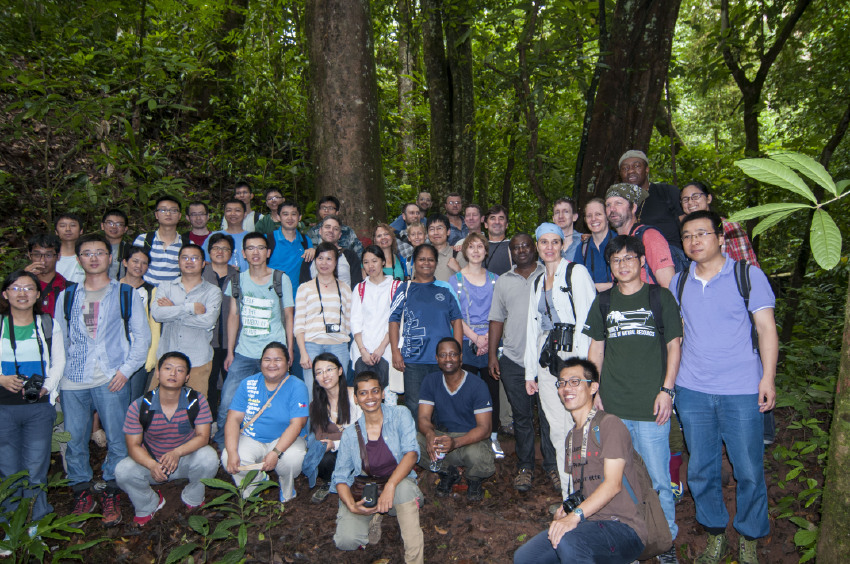
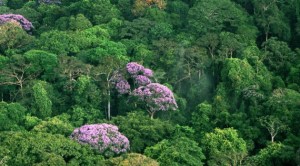
Forests contain a large fraction of the Earth’s biodiversity. But to what extent does the species composition of forests change over time, and to what extent is it stable? To address this question, we analysed data from 12 long-term Center for Tropical Forest Science plots around the world. Together, these plots contain over 2 million individual trees and over 4000 tree species and have been monitored for periods of 6 to 28 years. We found that forest communities are far from stable over time: the data are consistent with the hypothesis that environmental variables, such as climate, are causing strong fluctuations in tree species abundances at all 12 of our sites over time. This poses challenges to existing theories of biodiversity, which are based largely on notions of stability and demographic variance, and points the way to new theories that will give a more adequate explanation of forest dynamics.

The paper can be accessed here.

Imagelambir_palm

New paper with James O’Dwyer on species ages in neutral models published in Theoretical Population Biology

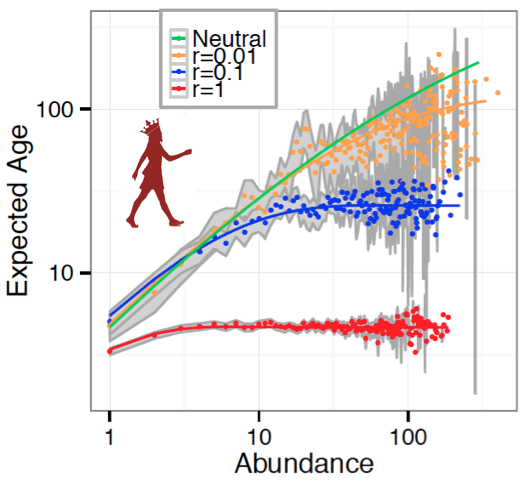
Neutral biodiversity models predict species ages that are unrealistically long—sometimes exceeding even the age of the Earth. But the exact extent of the problem with these models has been unknown until now, because we have lacked analytical species age formulas appropriate to ecological contexts. In our new paper, we have derived such formulas and used them to provide new neutral estimates of species ages of tropical trees. We show that neutral species ages are still too long, but by about a factor of ten less than previously thought.
http://www.sciencedirect.com/science/article/pii/S0040580914000161

species age formula
high-trees-2-630x350
Photo by Christian Ziegler

Richard Belcher joins the lab

Richard completed his Bachelor’s degree in Forestry at Bangor University in Wales and is now in the Environmental Management MSc programme at NUS. For his MSc thesis he will conduct an economic evaluation of the ecosystem services in Singapore’s Central Catchment Nature Reserve. Welcome, Richard!

Catharina Gallacher joins the lab

Catharina completed her MSc at Uppsala University, Sweden, her MRes at Imperial College London, UK, and her BSc at Anglia Ruskin University, UK. In her PhD she will use quantitative modelling tools to study the ecology and conservation of amphibians in Southeast Asia. Welcome, Catharina!