Category Archives: Uncategorized

Deepthi returns from field work in wetlands of Peninsular India

Deepthi recently finished her first season of field work in the agrarian landscapes of Peninsular India where she documented water bird diversity in 58 human-made wetlands. Using point count surveys, she recorded about 45,000 individuals of 78 species over three visits to each wetland.

She will use these data to estimate detection probabilities and abundances of the species and to understand patch and landscape correlates of water bird diversity.  She then plans to build patch-occupancy models to investigate questions pertaining to metapopulation dynamics and persistence.

New paper on the role of environmental variance in tropical forest dynamics in Ecology

Strong environmental forcings, from storms to fires and insect outbreaks to elephants, drive tree population dynamics in forests across the world. Despite the pervasiveness of these environmental drivers, most theoretical models of forest tree dynamics ignore them, focussing instead on neutral drift and niche stabilisation. What effect does environmental variance have on patterns of forest diversity? In our new paper, in press at Ecology, we show that a model with realistically strong environmental forcings can accurately reproduce both static and dynamic patterns of diversity in two tropical forest plots, one in Malaysia and one in Panama. This is superior to previous similar models that are unable to capture both types of diversity simultaneously—for example, neutral models are only able to realistically produce static patterns such as species-abundance distributions. Our work further underscores the need to include strong components of environmental variance in realistic models of tropical forest dynamics.

This work was led by Tak Fung, with Kassim Abd. Rahman and Christine Fletcher (Forest Research Institute Malaysia), and James O’Dwyer (Univ. of Illinois) as a collaborators.

Reproducing static and dynamic biodiversity patterns in tropical forests: the critical role of environmental variance. Tak Fung, James P. O’Dwyer, Kassim Abd. Rahman, Christine D. Fletcher and Ryan A. Chisholm, in press, Ecology.

1457704929

Poulsenia armata, a tree that was formerly dominant in the canopy at the Panama plot but suffered 50% mortality during a 1980s drought (image credit: biogeodb.stri.si.edu).

Mongabay article covers our forest drone research

A new article on Mongabay discusses the potential for drones and other automated technologies to be used for forest restoration. It covers recent developments in the field of automated forest restoration, including last year’s Chiang Mai workshop and our forest drone trials.

Forest restoration: from Stone Age to drone age

Forest restoration: from Stone Age to drone age

A drone that could be used to spray crops or forest plantations. The demonstration took place during a workshop on automated forest restoration this fall in Thailand. Photo by S. Elliott.
Photo by S. Elliott

Guest lectures for the Erasmus Mundus Masters programme in France

Ryan has just returned from France, where he gave a series of guest lectures and workshops to the Erasmus Mundus International Master in Applied Ecology programme at the University of Poitiers. This Masters programme draws in students from all around the world and allows students to rotate between different countries in the European Union over two years.

Ryan also visited and presented seminars at Jerome Chave’s lab at the University of Toulouse and at the Station for Theoretical and Experimental Ecology in Moulis, nestled in the foothills of the Pyrenees.

IMG_5333

New paper on termite evolution online at American Naturalist

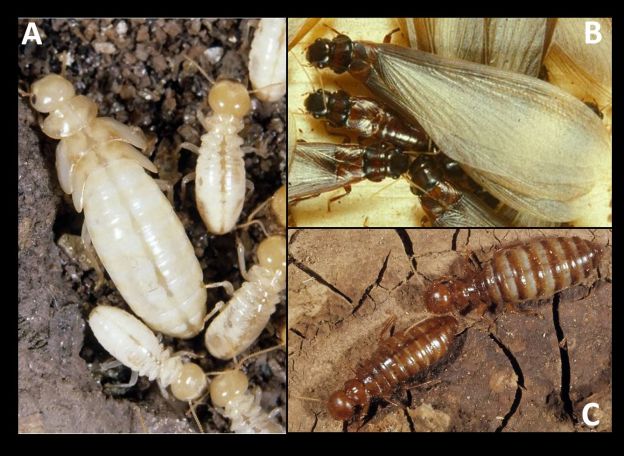
Our new termite evolution paper, led by Thomas Bourguignon, is now online at American Naturalist. The ancestors of termites were solitary cockroaches. Around 170 million years ago, something drove these cockroaches to become social and to have distinct castes. What were these driving forces and in what steps did termite evolution proceed? In bees and wasps sociality evolved first, and the distinct castes evolved second. In our new paper, we argue that the reverse occurred in termites. We present evidence that the first step in termite evolution was the appearance of a new wingless body type, as an alternative, terrestrial, strategy to the ancestral winged body type. The new wingless body type minimised the risks of aerial predation when dispersing. We propose that sociality in termites evolved only after the winged–wingless diphenism was well established.

Bourguignon, T., Chisholm, R.A. & Evans, T.A. (in press). The termite ‘worker’ phenotype evolved as a wingless dispersal strategy before eusociality. The American Naturalist.

termites

Individuals of the basal termite species, Mastotermes darwiniensis, including (A) a large juvenile nymph with smaller wingless non-reproductive workers, (B) winged reproductives (kings and queens), and (C) wingless reproductives. Photos by David McClenaghan, released on Commonwealth Scientific and Industrial Research Organization ScienceImage under the Creative Commons Attribution 3.0 unported license.


New paper on undetected extinctions in Conservation Biology

Many species are known to have vanished from the Earth over the last few hundred years. Over the same period, many new species have been discovered. Logically, there must be some species that went extinct without ever being discovered. How can we estimate these “undetected extinctions”? In a paper just published in Conservation Biology, we provide a new method for doing so. Our method is more flexible than previous methods because it does not rely on strong assumptions about extinction and detection rates being constant over time. Our method can be applied at both global and national levels.

We apply the new method to Singapore’s bird fauna over the last 200 years and estimate that, in addition to the 58 known extinctions out of 195 total known bird species, a further 9.6 species have gone extinct without ever being discovered (with a 95% confidence interval of [3.4, 19.8]).

Chisholm R.A., Giam X., Sadanandan K.R., Fung T. & Rheindt F.E. (2016). A robust non-parametric method for quantifying undetected extinctions. Conservation Biology.

trogon

The Scarlet-rumped Trogon (Harpactes duvaucelii) could conceivably be one of Singapore’s undetected extinctions: it is common in forests in nearby Johor but was never observed in Singapore itself (Photo credit: David Tan).


Catharina receives a grant from the National Geographic Society

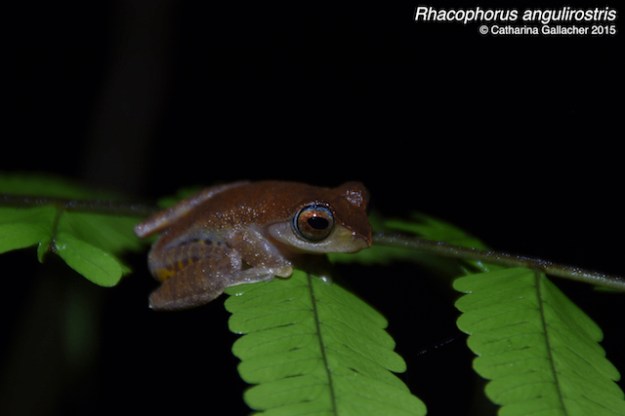
Catharina has been awarded a grant from the National Geographic Society. The grant will be used to set up automatic acoustic monitoring stations at her field sites on Mount Kinabalu and to support standard visual encounter survey work. She expects automatic acoustic monitoring to be more cost effective than visual surveys because of the steep terrain and dense vegetation. The stations set up for acoustic monitoring will also gather additional environmental data, such as humidity and temperature, which will then be transmitted back to a server. Catharina will also be working on developing new algorithms for classifying frog calls using a Bayesian framework.

DSC_0586-imp


Nega and Catharina attend 20th Biological Sciences Graduate Congress

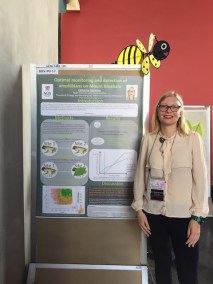
Nega and Catharina recently attended the 20th Biological Sciences Graduate Congress in Bangkok, Thailand. Nega presented a talk titled “The role of bird traits in predicting bird shifts in response to climate change” and Catharina presented a poster titled “Optimal Monitoring and detection of Amphibians on Mount Kinabalu”. The congress was a good opportunity to interact with graduate students from the other two Asian universities involved as well as with students in other biological disciplines from NUS.

IMG_0884