Category Archives: Uncategorized

Aloysius successfully defends his PhD thesis

Congratulations to Dr. Aloysius Teo for successfully defending his PhD thesis! Aloysius’ thesis is titled “Influence of biodiversity on ecosystem function in primary and secondary forests of Singapore: microclimate, litterfall, and decomposition”. His results improve our understanding of how ecosystem function in tropical secondary forests differs from that in primary forests—an especially important topic given that vast regions of the tropics are now dominated by secondary forests.

IMG_8241

Visit to University of Göttingen in Germany

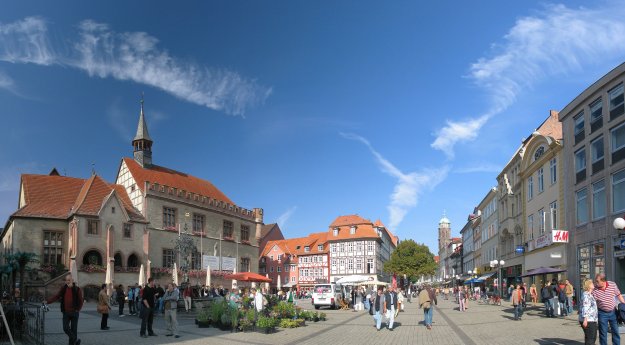
Ryan just returned from a trip to Germany to visit Holger Kreft’s lab at the University of Göttingen. He presented a seminar and discussed shared interests on the topic of island biogeography. He also learnt about the lab’s ecological research across Indonesia, from Sumatra to New Guinea. Göttingen has a history of working in Indonesia and training Indonesian scientists, going back to the 1980s.


Catharina attends Indo-Pacific Amphibian Symposium in Borneo

Catharina recently went to Sarawak in Borneo and attended the Indo-Pacific Amphibian Symposium held at Universiti Malaysia Sarawak (UNIMAS). The symposium comprised numerous presentations on ecology and conservation of amphibians in the region. Catharina also attended the annual Borneo Frog Race (also organised by UNIMAS) at the Gunung Gading National Park. This is a public outreach event aimed at creating awareness of and enthusiasm for amphibians among the public. The day was filled with workshops and the race itself, which is a race by the participants (not a race by the frogs themselves), in which each participant aims to find and photograph as many frog species as possible in a fixed amount of time.

Visit to Mathematical and Computational Biology group at the University of Melbourne

Last week Ryan visited members of the Computational Biology Research Initiative at the University of Melbourne. This research initiative seeks to facilitate interdisciplinary research in computational biology, between departments and schools within the university, and with external researchers. The university has also recently started up an undergraduate programme in Computational Biology.

Ryan presented a seminar, as part of the Mathematical and Computational Biology seminar series, about our lab’s recent work on island biogeography. He met with researchers whose work applies mathematical and computational techniques to a range of topics including epidemic diseases, cell biology and genetics.

binary-codes-for-web

Anne Chao visits the lab

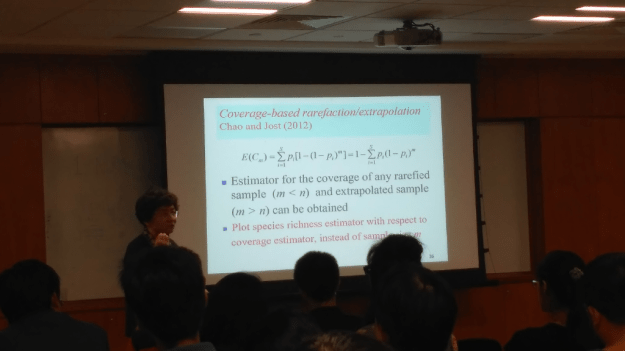
Anne Chao from National Tsing Hua University visited the lab last week to meet with students and staff and to present the weekly departmental seminar. Anne is well known for her extensive and rigorous contributions to ecological statistics and biodiversity estimation (including the Chao1 and Chao2 indices). Anne’s seminar was very well received, and our discussions with her stimulated new ideas for developing our own work on estimating undetected extinctions.

chao

New paper in Forest Ecology and Management on estimating carbon biomass of bamboo

Tak has co-authored a new paper on bamboo biomass estimation that has just been published in Forest Ecology and Management.

Bamboo species are widely distributed around the world, and often achieve high growth rates that favour the accumulation of carbon. However, a general understanding of the carbon storage potential of bamboo has been hindered by the restricted geographic and taxonomic scope of previous studies. To address this issue, Tak worked with Jiaqi Yuen and Alan Ziegler (Department of Geography, NUS) to produce a comprehensive review of existing studies of carbon storage estimates in bamboo. This review includes an assessment of how much carbon is stored by different groups of bamboo species in different geographic regions, and the proportional allocation among aboveground and belowground components. In addition, the review collates allometric equations important for estimating carbon storage in bamboo, and provides results from a new field study in Thailand illustrating the difficulties and uncertainties in determining the carbon storage potential of bamboo.

Overall, the review concludes that bamboo has the potential to be an important carbon sink relative to other types of land cover, provided that bamboo stands are managed efficiently and harvested bamboo is used in durable products. Therefore, bamboo could be given greater recognition in policy instruments aimed at mitigating the effects of climate change, such as the Kyoto Protocol.

Jia Qi Yuen, Tak Fung and Alan D. Ziegler. Carbon stocks in bamboo ecosystems worldwide: Estimates and uncertainties. Forest Ecology and Management 393 (2017): 113–138.

Bamboo_forest_Japan_Dariusz_Jemielniak

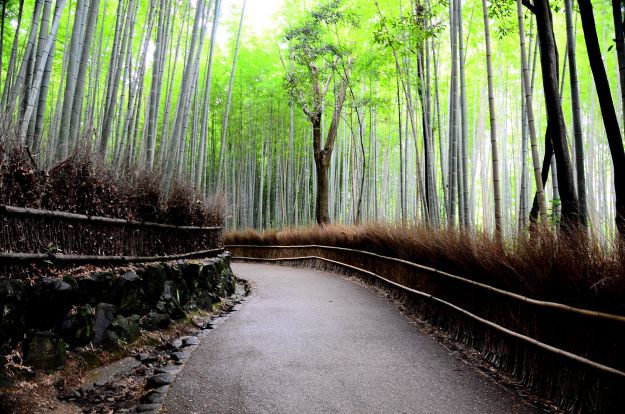
A bamboo forest in Kyoto, Japan. Photo credit: Dariusz Jemielniak (covered by a CC BY-SA 3.0 licence).


Paper on Singapore’s willingness-to-pay for haze mitigation online at Environmental Research Letters

How much are Singaporeans willing to pay for clean air? Singapore is blighted annually by haze drifting over from forest and peat fires in Indonesia. A particularly severe haze event occurred in 2015, with Singapore blanketed in foul air for nearly three months. The economic impacts of the haze include negative effects on transport, health and tourism. How much are these economic impacts worth? In this study just published online in Environmental Research Letters, we estimated these impacts indirectly using the contingent valuation method: we asked Singaporeans how much of their annual income they would be willing to sacrifice, e.g., in the form of a tax, to guarantee haze-free skies year round. The surveys used the double-bounded dichotomous choice method, and we scaled the results up from the sample of 390 individuals to Singapore as a whole. The paper was led by Honours student Lin Yuan.

Our final estimate for Singapore’s total annual willingness to pay was US$643.5 million (SGD 881.6 million). This number is on par with previous estimates of haze costs, derived from different methods, and is similar in magnitude to the estimated costs of proposed large-scale haze-mitigation programmes in Indonesia. Our results can thus inform future regional policy making with regards to haze mitigation.

Yuan Lin, Lahiru Wijedasa and Ryan A. Chisholm (2016). Singapore’s willingness to pay for mitigation of transboundary forest-fire haze from Indonesia. Environmental Research Letters

UPDATE: Our paper has been covered by TODAY newspaper.

Lahiru’s letters about peatland agriculture published in Global Change Biology and Science

Lahiru’s recently published letters in Global Change Biology and Science highlight the need for more research into sustainable peatland agricultural techniques. Current techniques lead to fires causing haze and high carbon emissions, and will eventually result in the long-term loss of agricultural land due to land subsidence and flooding. Developing peatland agriculture techniques that do not require drainage and result in a net positive carbon balance are the keys to a sustainable future for peatlands. While such techniques do not exist today, acknowledging the problem is the first step towards finding a solution.

L. S. Wijedasa, et al. (139 co-authors) (2016) Denial of long-term issues with agriculture on tropical peatlands will have devastating consequences. Global Change Biology (in press)

L. S. Wijedasa, S. E. Page, C. E. Evans, M. Osaki (2016) Time for responsible peatland agriculture. Science, 354:562.

Tak attends Models in Population Dynamics and Ecology conference in Marseille

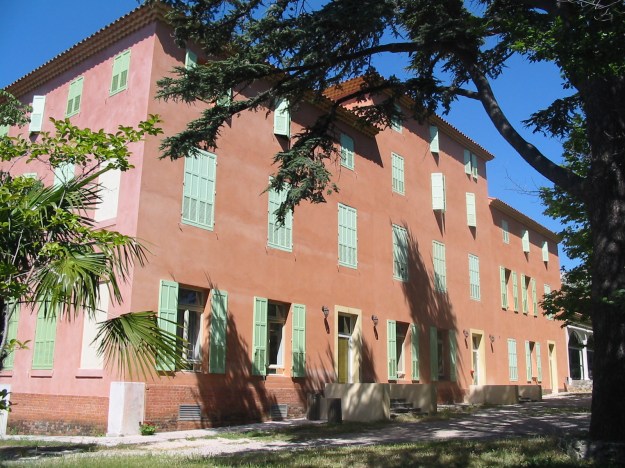
Tak has just returned from the Models in Population Dynamics and Ecology (MPDE) conference in Marseille, which was held over 5th-9th September at the Centre International de Rencontres Mathématiques (CIRM) at Aix-Marseille University. During the conference, Tak presented two new Markov Chain models describing how species abundances fluctuate under environmental variation. The models are novel in that they can be analysed to derive exact expressions for species richness and community abundance, allowing investigation of how these quantities change with increasing environmental variation, for example due to global climate change. Determining changes in richness and abundance is important because they are fundamental drivers of ecosystem functioning. In addition to presenting this work, Tak also took the opportunity to learn more about some of the latest developments in theoretical population biology and ecology, and connect with other researchers in this area.

cirm.jpg

Catharina attends World Herpetology Congress in China

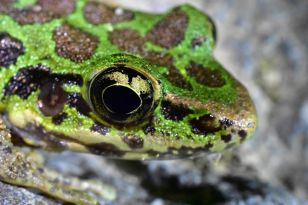
Catharina attended the World Herpetology Congress in China, where she presented a talk titled “Ansonia platysoma, the effect of habitat variables on occupancy”. She was able to attend the congress as she was awarded a partial scholarship by the congress that covered the registration fee, food and accommodation. She was also elected as a student member onto the congress committee.

frog.jpg    snake.jpg