Author Archives: ryanchisholm

Catharina attends International Congress for Conservation Biology in Montpellier

Catharina attended the joint International Congress for Conservation Biology (held jointly with the European Congress for Conservation Biology) in Montpellier, France, in August. She presented a talk titled “Training region effects on Species Distribution Model predictions: the effect of genus and life history traits”. Over 2000 people attended the congress. Her attendance at the congress was supported by a travel award from the organisers.

SAMSUNG CAMERA PICTURES

Catharina with Mark Burgman

Tak attends the Ecological Society of America’s 100th annual meeting in Baltimore

Tak attended the 100th Ecological Society of America (ESA) meeting in Baltimore, Maryland over 9th–14th August 2015. The conference was attended by over four thousand people. Tak presented his talk “Analyzing global tree and climate datasets to quantify the response of forest biodiversity to environmental change” in a session organised by the Center for Tropical Forest Science (CTFS), which consisted of a total of ten talks. The talk was about using tree census data from 21 CTFS plots worldwide to examine the relationship between tree species richness and environmental variability.

Baltimore

Tak attends Mathematical Models in Ecology and Evolution conference in Paris

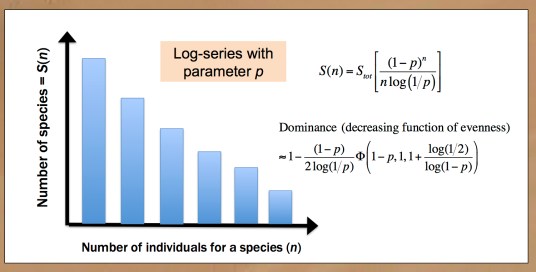
Tak attended the Mathematical Models in Ecology and Evolution conference at the Collège de France in Paris. This is one of the world’s biggest conferences in Mathematical Biology, and is held bi-annually. At the conference, Tak presented a talk on the derivation of analytical formulae specifying species-abundance distributions and species ages for ecological communities under coloured environmental noise.

Collège de France (Source: Wikipedia Commons)

Collège de France (Source: Wikipedia Commons)

Catharina travels to Borneo

Catharina spent 2.5 weeks in Borneo at the beginning of June. She attended the International Conference on Rainforest Ecology, Diversity and Conservation in Borneo. She met with local collaborators to develop contingency plans for her fieldwork following the earthquake that struck Mt Kinabalu on 5 June.

SAMSUNG CAMERA PICTURES

Polypedates colletti

Deepthi receives a grant from the Ruffords Foundation

Deepthi received a grant from the Ruffords Foundation, a UK based charity, that will support her PhD field work conducting water bird surveys in artificial wetlands of Peninsular India. She will also use this grant money to conduct workshops and training sessions for local communities in order to establish a long-term avian monitoring and conservation program.

Deepthi Ruffords

Tak’s paper on biodiversity loss and fish production published in Nature Communications

Fish provide essential minerals and proteins for humans, but unsustainable fishing practices have to led to severe declines in fish populations and loss of fish species at local and regional scales. A better understanding of how this species loss affects fish production in marine communities is important for better fisheries management. In Tak’s new paper, dynamic food-web models were used to examine how species loss affects fish production under a variety of scenarios of species loss. Fish production followed a unimodal relationship or a monotonic concave or convex decline with species loss; interestingly, prey of deleted species tended to respond with an increase in production, thus mitigating loss of production in the deleted species.

Fung, T., K. D. Farnsworth, D. G. Reid, and A. G. Rossberg. 2015. Impact of biodiversity loss on production in complex marine food webs mitigated by prey-release. Nature Communications. 6:6657

Tuna

Photo credit: National Oceanic and Atmospheric Administration/Department of Commerce; Danilo Cedrone; United Nations Food and Agriculture Organization

Food web

Trophic connections in an example food web generated using the model in the paper

Honours students’ theses submitted

Brenda, Lena, Jessica and Xue Qin have submitted their Honours theses. Brenda analysed patterns of species invasion in cities and nature reserves across the world. Lena examined whether particular traits make bird species more adaptable to urban parks in Singapore. Jessica conducted an analysis of ecosystem services in Sabah, Malaysia. Xue Qin estimated the indirect economic value of Southeast Asian ecotourism to Singapore. Congratulations to all of them!

IMG_3282