
The ability of a scientific model to make accurate predictions is an important criterion for assessing its validity, but in ecology there are relatively few studies that have made and tested true a priori predictions, i.e., predictions of unseen data. In a study led by Tak and just published in Ecology Letters, we tested several ecological models’ predictions of unseen higher-order diversity patterns in island archipelago data.
Specifically, we (i) fitted a suite of mechanistic models to observed values of alpha diversity (i.e., number of species on each island) for each of 17 archipelagos, (ii) used the fitted models to make quantitative predictions of three higher-order patterns of island biodiversity, and (iii) quantitatively tested the predictions. The 17 datasets represented a wide range of taxa (including plants, birds and mammals) and archipelago types (including marine and inland water) (Fig. 1). Importantly, the predicted patterns of biodiversity represent higher orders of diversity that contain information absent in alpha diversity, namely the number of species shared between each pair of islands, the number of species shared among each triplet of islands, and the occupancy–frequency distribution that shows the frequency distribution of the number of islands occupied by species in an archipelago.
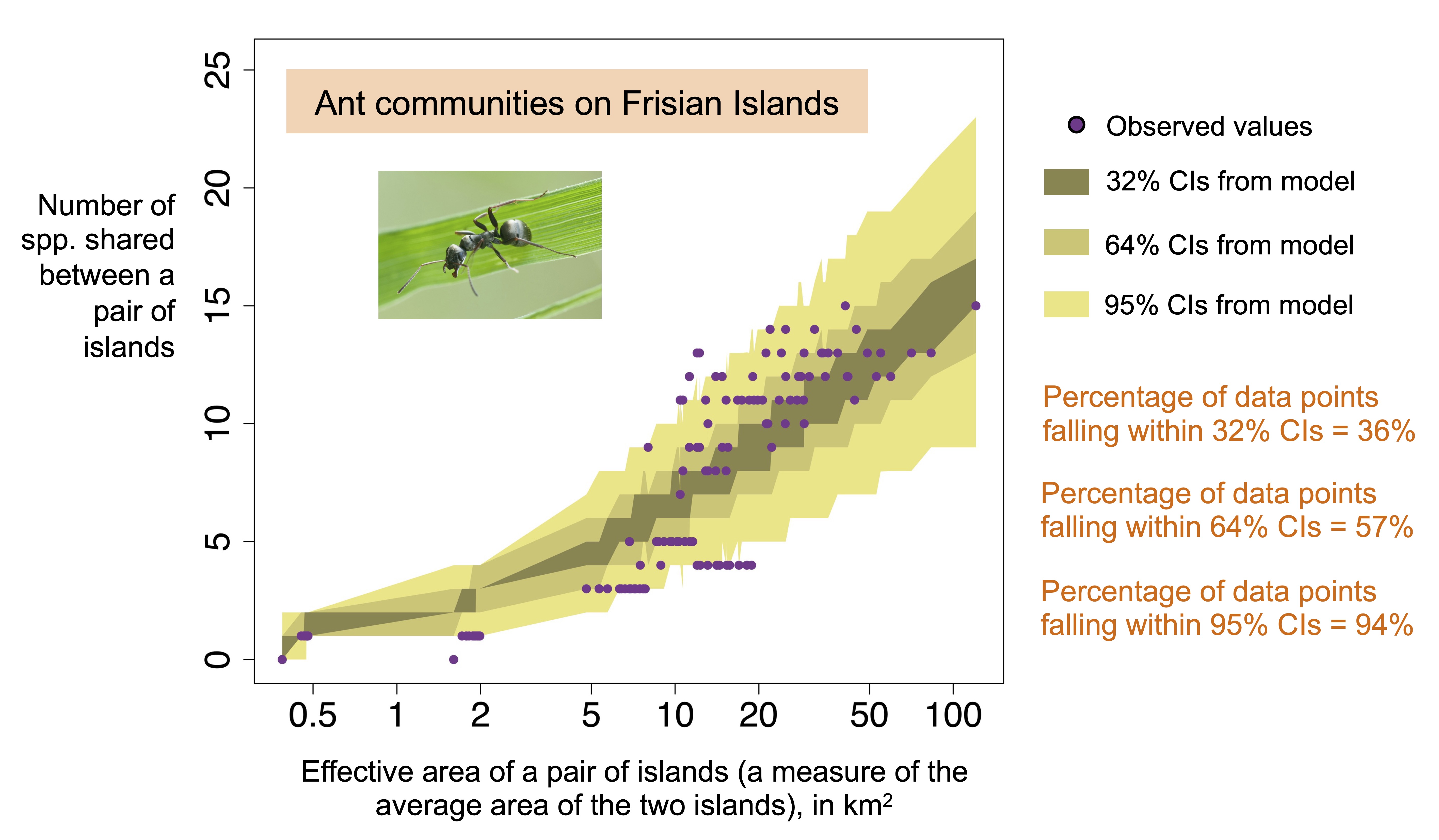
Our central finding is that an individual-based neutral model of island community dynamics produced fairly good predictions of island biodiversity (e.g., Fig. 2). This suggests that stochastic neutral competition among species together with dispersal limitation is a parsimonious explanation for multiple patterns of island biodiversity. A non-neutral version of the model that included coarse niche structure had worse predictive ability, probably due to overfitting. Our study is a clarion call for further efforts to test true predictions in ecology, in particular using mechanistic models to shed light on the processes structuring ecological systems in nature.

 Chisholm Lab
.jpg)
.jpg)