Tag Archives: biodiversity

Tak’s new paper on testing model predictions of higher-order species diversity on islands published in Ecology Letters

The ability of a scientific model to make accurate predictions is an important criterion for assessing its validity, but in ecology there are relatively few studies that have made and tested true a priori predictions, i.e., predictions of unseen data. In a study led by Tak and just published in Ecology Letters, we tested several ecological models’ predictions of unseen higher-order diversity patterns in island archipelago data.

Specifically, we (i) fitted a suite of mechanistic models to observed values of alpha diversity (i.e., number of species on each island) for each of 17 archipelagos, (ii) used the fitted models to make quantitative predictions of three higher-order patterns of island biodiversity, and (iii) quantitatively tested the predictions. The 17 datasets represented a wide range of taxa (including plants, birds and mammals) and archipelago types (including marine and inland water) (Fig. 1). Importantly, the predicted patterns of biodiversity represent higher orders of diversity that contain information absent in alpha diversity, namely the number of species shared between each pair of islands, the number of species shared among each triplet of islands, and the occupancy–frequency distribution that shows the frequency distribution of the number of islands occupied by species in an archipelago.

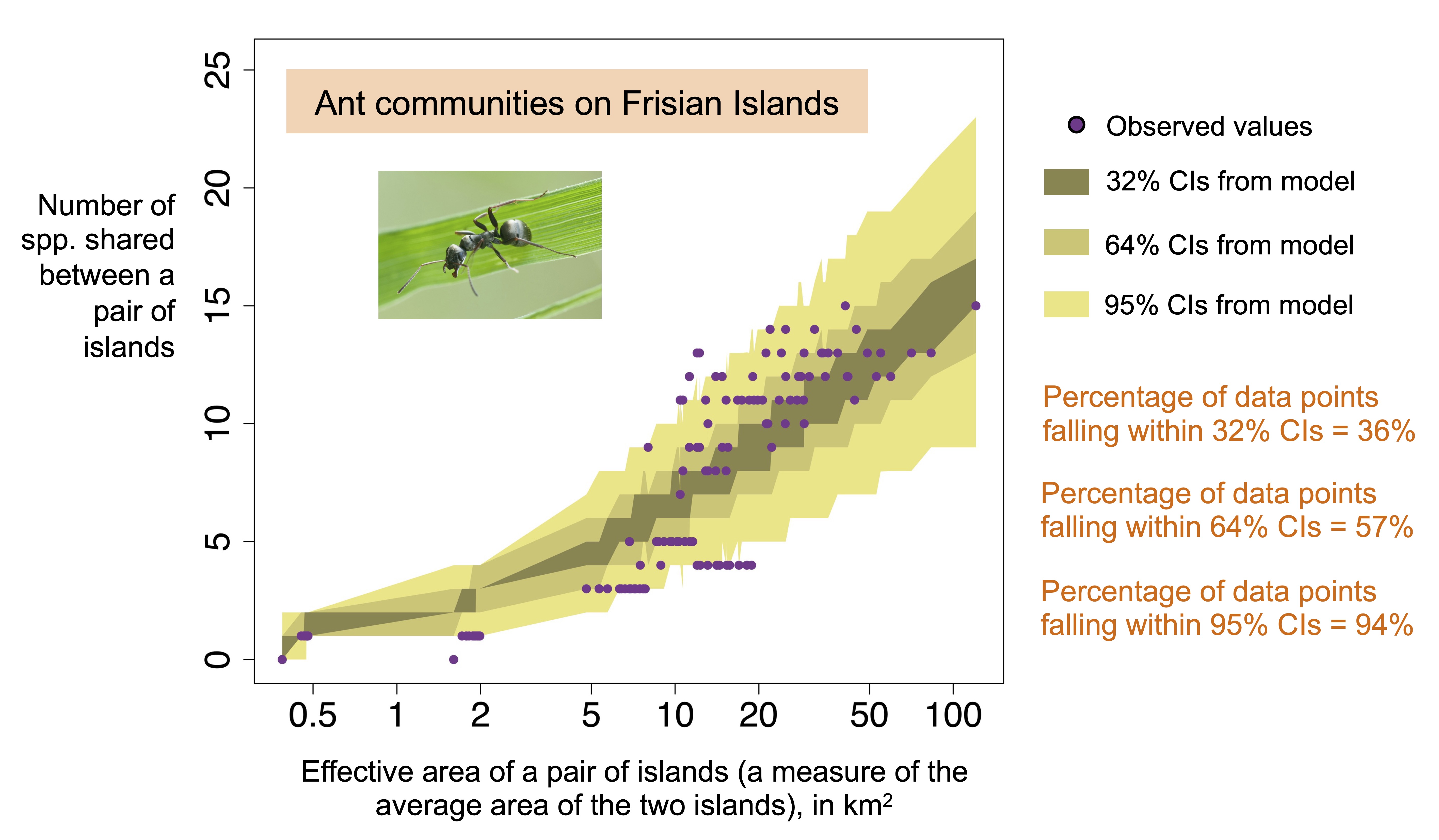
Our central finding is that an individual-based neutral model of island community dynamics produced fairly good predictions of island biodiversity (e.g., Fig. 2). This suggests that stochastic neutral competition among species together with dispersal limitation is a parsimonious explanation for multiple patterns of island biodiversity. A non-neutral version of the model that included coarse niche structure had worse predictive ability, probably due to overfitting. Our study is a clarion call for further efforts to test true predictions in ecology, in particular using mechanistic models to shed light on the processes structuring ecological systems in nature.

Fig. 1. An aerial view of Baltrum, one of the Frisian Islands in the North Sea. The Frisian Islands form one of the 17 archipelagos that we examined. This photo was taken by Carsten Steger and used in an unaltered form under a CC BY-SA 4.0 license.
Fig. 2. For ant communities on the Frisian Islands (17 islands), the observed relationship between number of species shared between each pair of islands and the average area of the islands (points) is accurately predicted by an individual-based neutral model fit only to the observed relationship between the number of species on each island and island area (this information by itself imposes only very weak constraints on the quantity being predicted). The proportion of points that fall within each confidence interval (shaded regions) closely tracks the nominal coverage of the interval (see text at right). The photo shows an ant of the species Formica fusca, which is found on the Frisian Islands. The photo was taken by Mathias Krumbholz and used in an unaltered form under a CC BY-SA 3.0 license.

New paper on spatial synchrony of forest tree population dynamics published in Proceedings of the Royal Society B

Light red meranti (Shorea parvifolia) is a canopy tree species native to tropical forests in Southeast Asia that can grow to over 65 m. In the two decades to 2005, the abundance of light red meranti decreased by 60% in a ForestGEO research plot in Pasoh, Malaysia. In a ForestGEO plot in Lambir, Malaysia, over 1000 km away, the same species decreased by 25% over a similar period. This example prompts the question of whether forest tree population dynamics are in general synchronised across space. In a paper just published in Proceedings of the Royal Society B, we found that the answer is yes.

We collated forest inventory data at three different scales—local, regional and global—and found signals of synchrony up to scales well beyond 100 km. For the Pasoh and Lambir forests, in particular, there was clear evidence of synchrony for larger trees (greater than 10 cm diameter) although not for smaller trees. A technical challenge in our analyses was developing statistical methods to produce an aggregate estimate of synchrony for each pair of forest sites while accounting for the noise inherent in datasets with large numbers of rare species. Although existing methods are available to estimate synchrony for individual species, these were not appropriate for our forest data because of the short duration of our datasets (a few decades at most) relative to the typical tree generation time. Our novel methods make use of copulas, which are used to model multivariate statistical phenomena in quantitative finance.

We attributed the observed synchrony in tree population dynamics to synchronised environmental drivers, such as climate, although we lacked the statistical power to identify particular drivers. The observed synchrony suggests greater risk of extinction for tree species that are more spatially constrained, especially those with range dimensions less than ~100 km. On the other hand, species with larger ranges may be buffered from extinction by the lack of synchrony in their population dynamics across space.

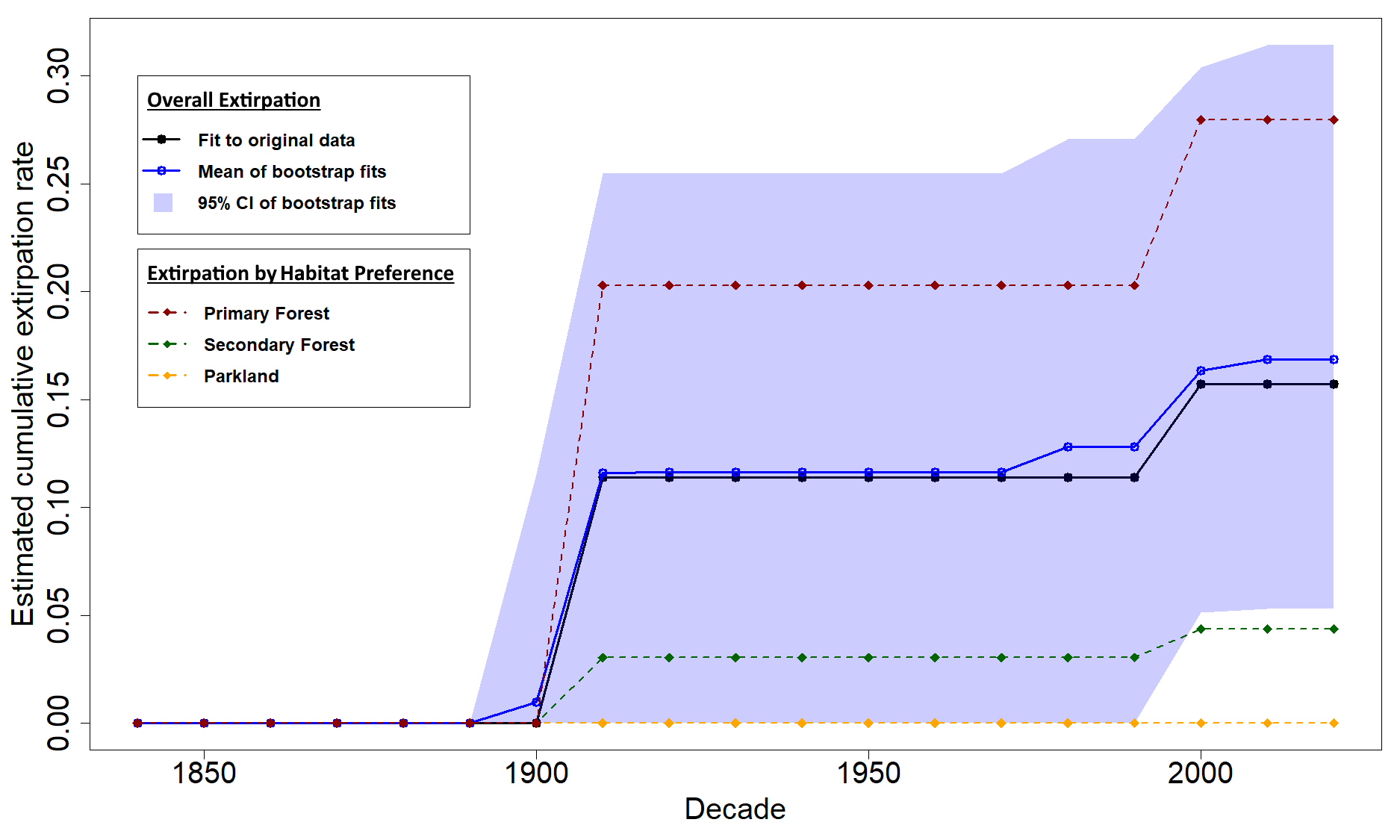
Forest tree population dynamics are synchronised across space, with synchrony detectable even beyond 100 km. Dark blue, light blue and green curves indicate the results of local, regional and global analyses. Line types indicate the spatial grain of each analysis: synchrony is lower for smaller spatial grains because of immigration.

Chisholm, R. A., T. Fung, K. J. Anderson-Teixeira, N. A. Bourg, W. Y. Brockelman, S. Bunyave- jchewin, C.-H. Chang-Yang, Y.-Y. Chen, G. B. Chuyong, R. Condit, H. S. Dattaraja, S. J. Davies, S. Ediriweera, C. E. N. Ewango, E. S. Fernando, I. A. U. N. Gunatilleke, C. V. S. Gunatilleke, Z. Hao, R. W. Howe, D. Kenfack, T. L. Yao, J.-R. Makana, S. M. McMahon, X. Mi, M. Bt. Mohamad, J. A. Myers, A. Nathalang, Á. J. Pérez, S. Phumsathan, N. Pongpattananurak, H. Ren, L. J. V. Rodriguez, R. Sukumar, I.-F. Sun, H. S. Suresh, D. W. Thomas, J. Thompson, M. Uriarte, R. Valencia, X. Wang, A. T. Wolf, and J. K. Zimmerman (2024) Assessing the spatial scale of synchrony in forest tree population dynamics. Proceeding of the Royal Society B 291: 20240486

Fanhua’s paper on tree diversity in gaps in tropical forests published in Ecology

Kong Fanhua was a visiting PhD student in our lab in 2022–2023, during which time she worked on a study of tropical forest gap diversity that has just been published in Ecology. Forest gaps are created when large trees fall. Gaps experience greater below-canopy light levels than non-gaps and thus see increased recruitment of young trees. It has long been hypothesised that forest gaps have higher tree diversity than non-gaps, but surprisingly until now there has not been a satisfactory statistical test of the hypothesis. We focussed our analyses on the 50 ha forest plot on Barro Colorado Island in Panama, leveraging regular forest census data going back decades, as well as canopy-height survey data that facilitated gap identification.

Our main finding was that although the average number of tree species in any given gap was only slightly higher than a same-sized non-gap site, collections of gaps had many more species than similar collections of non-gaps. We identified 124 newly formed gaps (each 25 m2) in 2003 and when these were seven years old they contained 149 tree species in total compared to only 109 tree species in a comparable collection of non-gap sites. Qualitatively similar, but somewhat weaker, results were observed when the gaps were two and 12 years old. These notable differences between gaps and non-gaps strongly indicate an important role for gaps in the maintenance of plot-level tree diversity.

Fanhua now holds a post-doctoral research position at the Nanjing Institute of Environmental Sciences.

Kong, F., H. Fangliang, and R. A. Chisholm. (in press) High beta diversity of gaps contributes to plot-level tree diversity in a tropical forest. Ecology

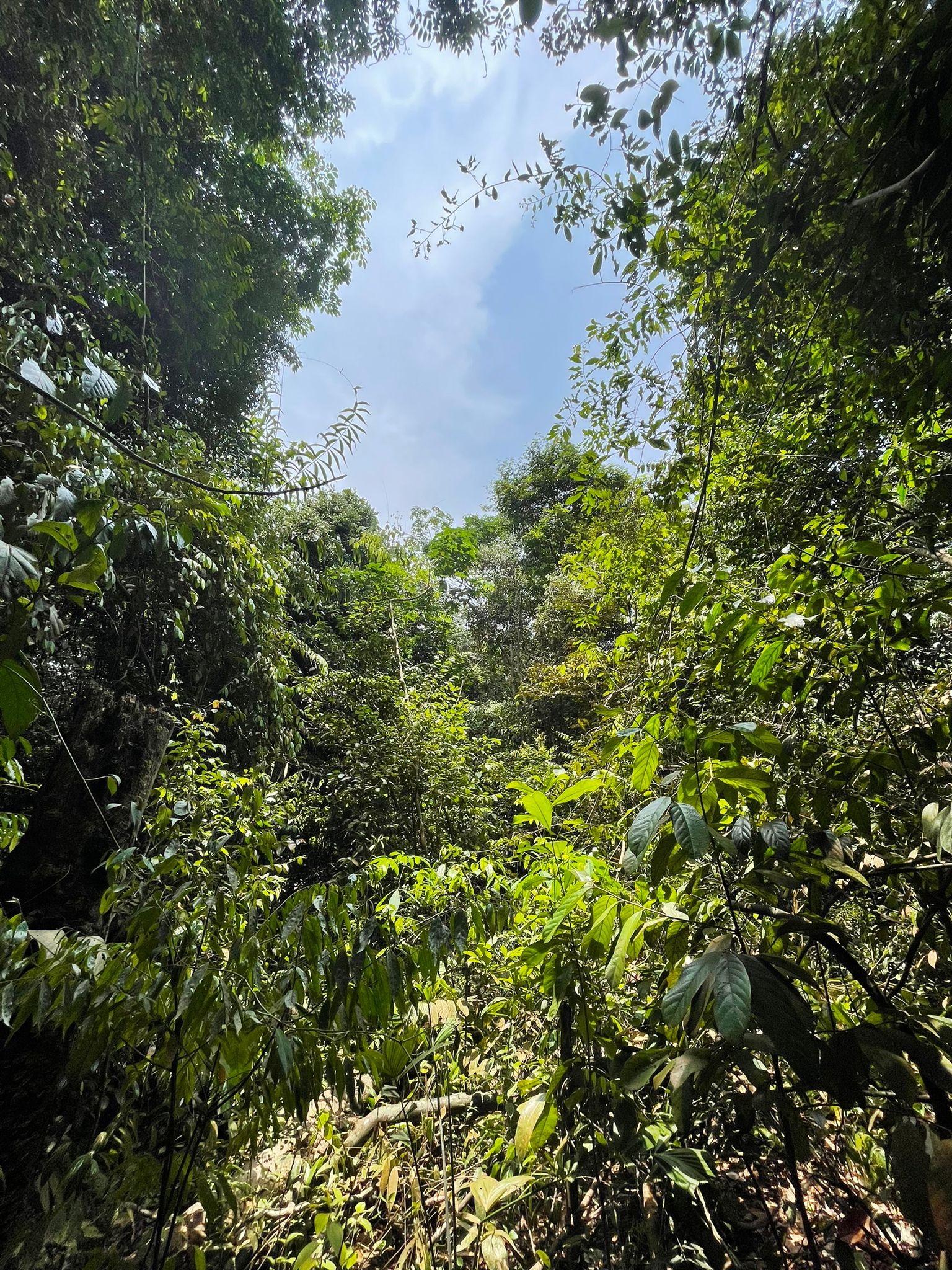
A tropical forest gap (photo credit: Rachel Lim)

New coauthored Nature paper on the impacts of conspecific neighbours on forest tree survival

To explain high tropical forest tree species diversity, ecologists have hypothesised that pests, pathogens and resource limitation keep the abundances of common tree species in check, thereby allowing rare tree species to persist. If this hypothesis is true then individual trees surrounded by more neighbours of the same species should have lower survival. This is known as conspecific negative density dependence (CNDD). Past tests of the CNDD hypothesis have been criticised for statistical flaws, mainly arising from the use of static data (see here and here). In a study led by Lisa Hülsmann of the University of Bayreuth and just published in Nature, we conducted a comprehensive test of the hypothesis using a dynamic data set comprising repeated censuses of 23 forest plots from the global ForestGEO network.

We found that average CNDD across tree species is generally weak and exhibits little relationship to latitude, contrary to the hypothesis that CNDD explains high tropical tree diversity. Moreover, CNDD was extremely variable across species within a forest, which may limit its ability to maintain diversity. However, CNDD was higher for rare than common species in the tropics, suggesting that CNDD plays a stronger role in structuring abundances in the tropics. Our results paint a more nuanced picture of the role of CNDD in forest community ecology, and point to future experimental and theoretical studies that will be needed to clarify this role further.

The idea for this study arose when Ryan visited Lisa Hülsmann and Florian Hartig at the University of Regensburg, Germany in 2018. The paper is a collaboration between 52 authors, primarily associated with the different ForestGEO plots around the world.

Hülsmann, L., R. A. Chisholm, L. Comita, M. D. Visser, M. de Souza Leite, S. Aguilar, K. J. Anderson-Teixeira, N. A. Bourg, W. Y. Brockelman, S. Bunyavejchewin, N. Castaño, C.-H. Chang-Yang, G. B. Chuyong, K. Clay, S. J. Davies, A. Duque, S. Ediriweera, C. Ewango, G. S. Gilbert, J. Holík, R. W. Howe, S. P. Hubbell, A. Itoh, D. J. Johnson, D. Kenfack, K. Král, A. J. Larson, J. A. Lutz, J.-R. Makana, Y. Malhi, S. M. McMahon, W. J. McShea, M. Mohamad, M. Nasardin, A. Nathalang, N. Norden, A. A. Oliveira, R. Parmigiani, R. Perez, R. P. Phillips, N. Pongpattananurak, I.-F. Sun, M. E. Swanson, S. Tan, D. Thomas, J. Thompson, M. Uriarte, A. T. Wolf, T. L. Yao, J. K. Zimmerman, D. Zuleta, and F. Hartig. 2024. Latitudinal patterns in stabilizing density dependence of forest communities. Nature https://doi.org/10.1038/s41586-024-07118-4

Pasoh Forest Reserve, in Peninsular Malaysia, is the site of one of the 23 ForestGEO plots used in our analyses. Photo credit: ForestGEO