As part of a talk series on modelling physical, biological and social phenomena run by Alphabet (Google’s parent company), Ryan presented an online seminar about our lab’s work on ecological modelling. He talked about our Singapore extinctions project, our research programme on the maintenance of diversity, and potential novel applications of optimised individual-based ecological models to video games and virtual reality applications.
Category Archives: Uncategorized
Special Programme in Science students win best presentation award for their Integrated Science Project
Over the last six months, three undergraduate Special Programme in Science students, Chin Zhen Jie, Andrew Teoh, and Cheng Jun Yuan (pictured left to right, below), have been conducting a project in our lab for their Integrated Science Project. They built a computational model to explore the joint effect of stage structure and conspecific negative density dependence on forest tree biodiversity. Their main result was that stage structure enhanced the diversity generated by density dependence. They recently completed their report, underwent a viva voce, gave a poster presentation, and gave a slide presentation at the Special Programme in Science student congress. For the latter, they won the best presentation award. Congratulations, guys!
The Special Programme in Science was established in 1996 at NUS to nurture enthusiastic students with a passion for science. The students take six tailor-made courses over the first two years of their degree, including the Integrated Science Project in the second year.

New modelling paper on impact of non-pharmaceutical interventions on total disease burden published in the Journal of Theoretical Biology
Infectious diseases exert a large burden on the well-being of human societies, as vividly illustrated by the recent COVID-19 pandemic. In response to an infectious disease, governments enact a variety of non-pharmaceutical interventions (NPIs) such as social-distancing guidelines, mask-wearing mandates and lockdowns. These NPIs reduce spread of the virus causing the target disease, and also reduce spread of other viruses that cause non-target diseases. For example, NPIs enacted during the COVID-19 pandemic reduced the spread of non-target respiratory diseases caused by influenza and respiratory syncytial virus (RSV). However, due to lack of pharmaceutical interventions aimed at these non-target diseases (such as vaccinations), they often rebounded to levels higher than pre-pandemic levels after the NPIs were relaxed. Thus, the net effect of NPIs on the long-term total disease burden of non-target diseases is unclear.
This knowledge gap was addressed in a new study by Tak, Ryan and Jonah Goh (former Honours student at Chisholm Lab), recently published in the Journal of Theoretical Biology. We considered a scenario where NPIs were enacted for a year and then completely removed. Under this scenario, we analysed a suite of four epidemiological models of varying generality and complexity, to quantify the net effect of the NPIs on the long-term total disease burden of a seasonal, non-target respiratory disease.
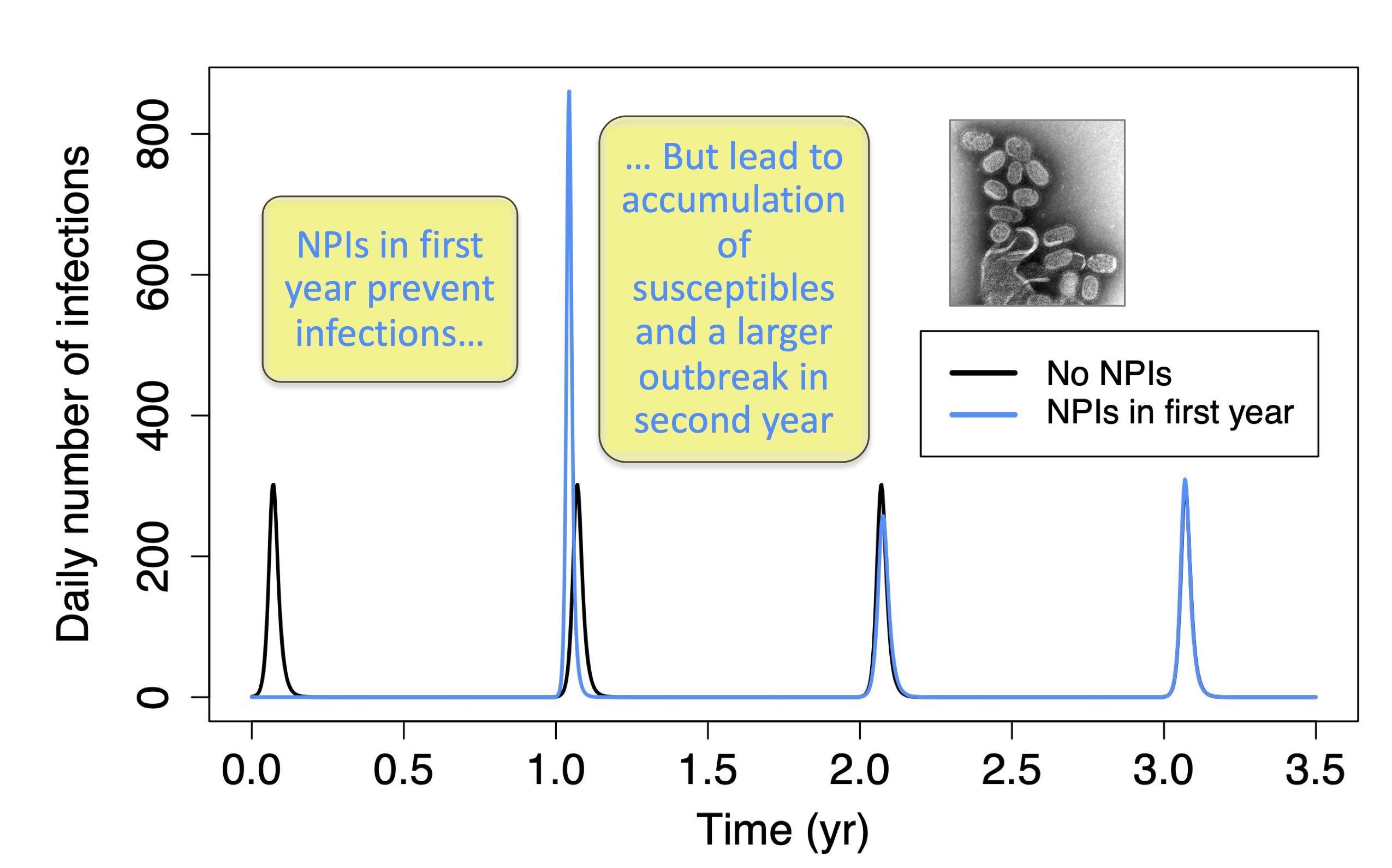
The simplest model of the four was a SIR model with seasonal disease outbreaks and temporary immunity of recovered individuals. For this model, we performed a rigorous mathematical analysis to show that the net effect of NPIs was always to reduce the long-term total disease burden. The number of susceptible individuals increased during the year when NPIs were enacted and this led to the number of infections rebounding to high levels after the NPIs were removed (Fig. 1). But this was more than offset by the number of infections prevented by the NPIs when they were being applied (Fig. 2). We found that the net reduction in the number of infections depended critically on the rate at which immunity was lost. In the extreme case of near-permanent immunity, the pool of susceptible individuals remained small and resulted in small outbreaks, such that the NPIs produced a small net reduction in the number of infections. However, as immunity was lost more quickly, the size of outbreaks increased commensurately and the NPIs produced increasingly larger net reductions in the number of infections, with the net reduction reaching large values of 70-100% of population size when immunity loss occurred quickly (on the order of months).
These key results from the simplest model were supported by simulations of the three more-complex models, which were parameterised for specific locations including Singapore and China. Overall, our study highlights a hitherto under-appreciated role of NPIs in reducing the long-term total disease burden of non-target diseases, which should be factored into cost-benefit assessments of NPIs in public health management.

New coauthored Nature paper on the impacts of conspecific neighbours on forest tree survival
To explain high tropical forest tree species diversity, ecologists have hypothesised that pests, pathogens and resource limitation keep the abundances of common tree species in check, thereby allowing rare tree species to persist. If this hypothesis is true then individual trees surrounded by more neighbours of the same species should have lower survival. This is known as conspecific negative density dependence (CNDD). Past tests of the CNDD hypothesis have been criticised for statistical flaws, mainly arising from the use of static data (see here and here). In a study led by Lisa Hülsmann of the University of Bayreuth and just published in Nature, we conducted a comprehensive test of the hypothesis using a dynamic data set comprising repeated censuses of 23 forest plots from the global ForestGEO network.
We found that average CNDD across tree species is generally weak and exhibits little relationship to latitude, contrary to the hypothesis that CNDD explains high tropical tree diversity. Moreover, CNDD was extremely variable across species within a forest, which may limit its ability to maintain diversity. However, CNDD was higher for rare than common species in the tropics, suggesting that CNDD plays a stronger role in structuring abundances in the tropics. Our results paint a more nuanced picture of the role of CNDD in forest community ecology, and point to future experimental and theoretical studies that will be needed to clarify this role further.
The idea for this study arose when Ryan visited Lisa Hülsmann and Florian Hartig at the University of Regensburg, Germany in 2018. The paper is a collaboration between 52 authors, primarily associated with the different ForestGEO plots around the world.

Aloysius’s paper on litterfall in forests in Singapore published in Journal of Tropical Ecology
Aloysius finished his PhD in our lab several years ago, and another chapter from his thesis has just been published. The paper reports on work he did assessing leaf litter turnover and nutrient dynamics in forests in Singapore, looking at differences between old-growth forests and novel forests. The novel forests have arisen in the last few decades from cleared farmland and villages. His main findings were that leaf litter decays much faster in novel forests than in old-growth forests, resulting in a litter pool only one third the size, and that phosphorus is highly elevated in the litter of novel forests. The differences may be attributable to dominance of exotic tree species in novel forests. The reduced litter pools in novel forests have negative consequences for ecosystem carbon balance and climate change mitigation. This may have broad relevance because of the increasing prevalence of novel forests across the tropics.
Tak’s review on models of temporal environmental stochasticity published in Mathematical Biosciences
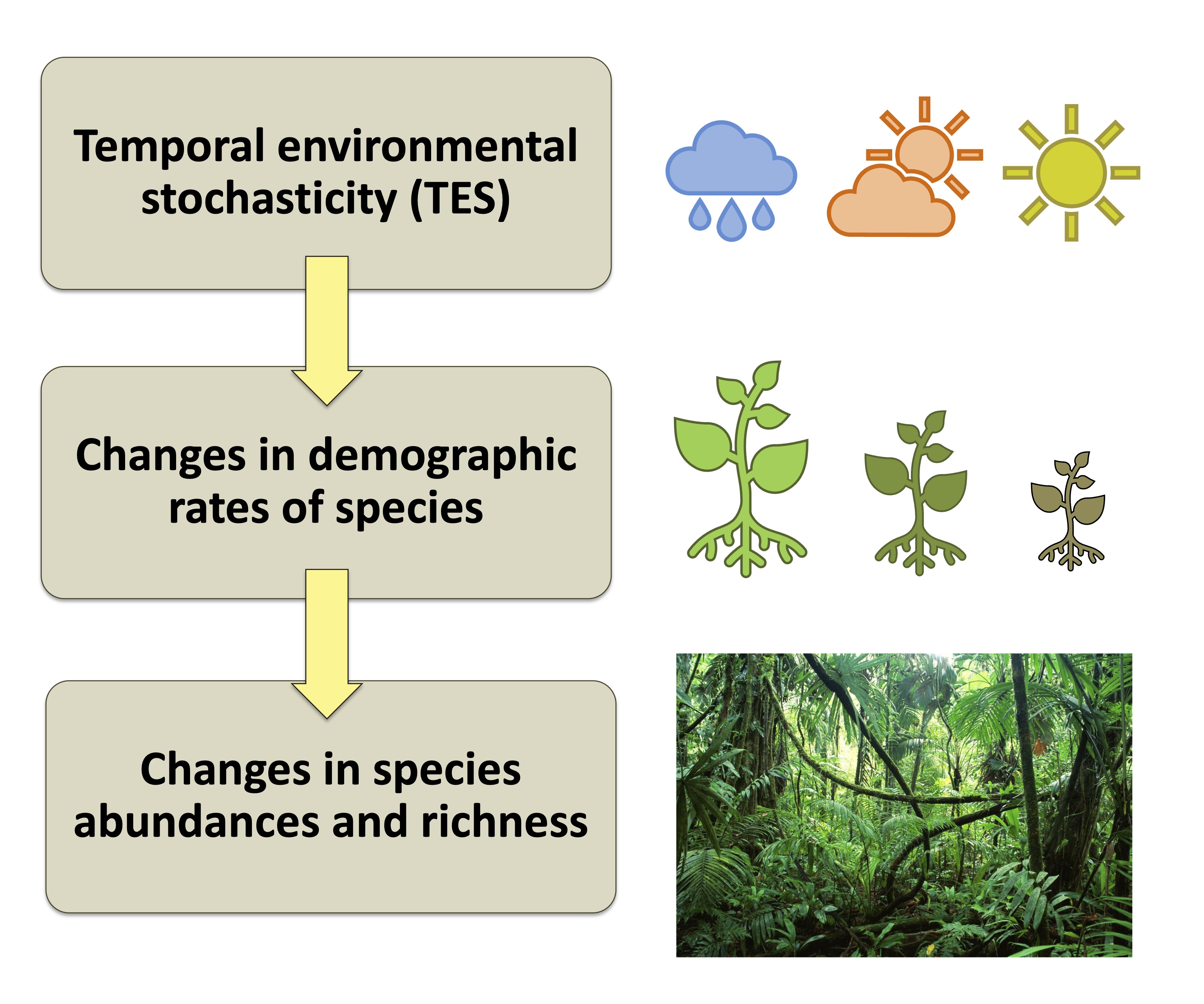
The ancient Greek philosopher Heraclitus espoused that life is continuously in a state of flux, and this is attested by the ubiquity of temporal changes in environmental conditions such as precipitation and temperature, which are often well characterised by a random process and referred to as temporal environmental stochasticity (TES). TES results in random changes in species’ demographic rates over time, with profound cascading effects on community dynamics and species richness. This is the topic of a new review paper published in Mathematical Biosciences, authored by Tak and Ryan in collaboration with colleagues Jayant Pande from FLAME University, Nadav Shnerb from Bar-Ilan University and James O’Dwyer from the University of Illinois.
In our review, we synthesise studies that have analysed process-based community models to quantitatively examine how TES affects species richness. The simplest community models assume that species interactions are so weak that they can be ignored, such that community dynamics are essentially the sum of independent species dynamics, thus being amenable to mathematical analysis. More complex community models incorporate non-negligible interspecific interactions, which renders them more difficult to analyse. However, techniques from “mean-field theory” can be used to represent the strengths of interspecific interactions as time-averaged constants, such that community dynamics can be represented effectively as the sum of independent species dynamics and analysed.
Our review identified important processes via which TES affects species richness. Firstly, TES increases temporal fluctuations of species populations, such that the variance in species abundance over a particular time period scales quadratically with the initial abundance, in contrast to the linear scaling found in the absence of TES. The greater TES-induced fluctuations tend to promote species extinctions by bringing the abundances of species more frequently to the extinction threshold, thus decreasing species richness. Secondly, in competitive communities, non-linear averaging of TES-induced temporal fluctuations in interspecific competition strength (via Jensen’s inequality) can result in weaker interspecific competition on average, thus increasing species richness. However, this effect only dominates when the temporal correlation of environmental conditions is sufficiently short. If the correlation is too long, then this allows strong selection of the fittest species between infrequent changes in environmental conditions, which decreases species richness.
We end our review by discussing fruitful avenues for further research. These include a greater focus on interspecific interactions other than competition, for example consumption and mutualism. They also include examining eco-evolutionary feedbacks that critically shape the response of a species to TES, which may mitigate the effects of TES. Furthermore, there is much scope to explore how TES affects species richness in spatially explicit settings. Successful exploration of these new avenues requires development of new theory, collection of more community data, and better integration between theory and data.
Tak coauthors a new paper modelling the effect of habitat loss on genetic diversity
Habitat destruction is one of the greatest threats to biodiversity worldwide, yet the effects of habitat loss and fragmentation on genetic diversity remain unclear. Tak has coauthored a new study published in Biological Conservation that provides new insights on this topic, using mathematical analyses and simulations of population genetic models. The study was led by Qian Tang, who is a Senior Research Fellow from Frank Rheindt’s Avian Evolution Lab at NUS.
The study found that for model bird species with different dispersal abilities, the amount of habitat lost had greater negative effects on population-level genetic diversity than did the degree of habitat fragmentation over timescales of a few hundred years. This was because the amount of habitat lost had the biggest negative impact on population sizes, which led to increases in genetic drift. The loss of genetic diversity manifested itself slowly over several decades, due to genetic drift acting slowly to remove alleles at the population level. This time lag provided a window of opportunity to rebuild populations and reduce the genetic extinction debt. However, loss of genetic diversity occurred more quickly at the subpopulation level due to spatial isolation of individuals and associated inbreeding, which accelerated loss of alleles in subpopulations via genetic drift. Species with higher dispersal abilities were more affected by habitat loss and fragmentation because they were more likely to disperse to areas with unsuitable habitat.
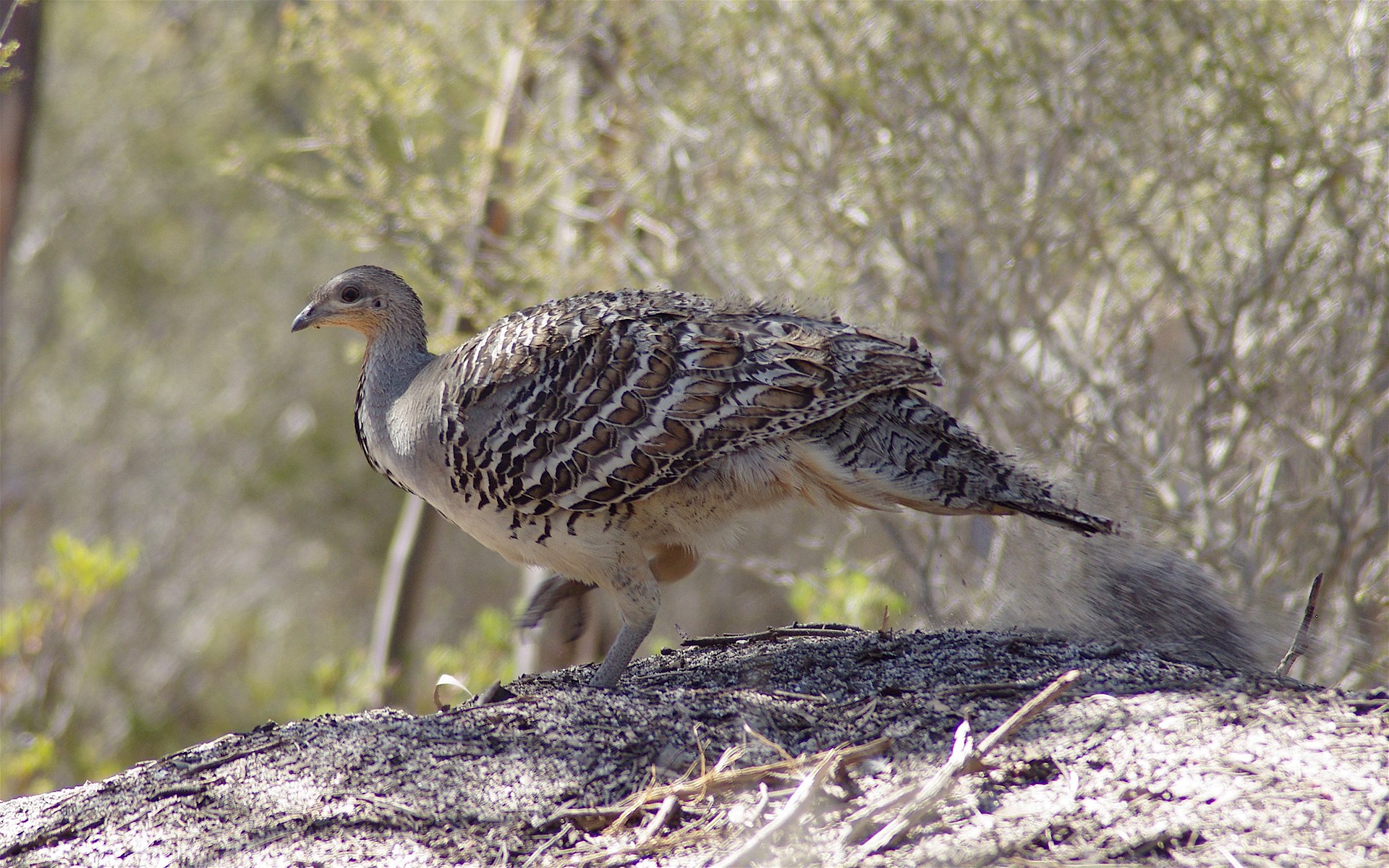
The study also used modelling to examine a case study of how habitat destruction reduced genetic diversity in populations of malleefowl (Leipoa ocellata) in South Australia. The empirical trends in genetic diversity under different levels of habitat loss and fragmentation broadly matched those found for the model bird species. In addition, the modelling exercise revealed that small sample sizes blurred the effects of habitat loss and fragmentation, suggesting that caution should be taken when interpreting results from empirical studies with sparse sampling.
Our new PNAS paper on historical extinctions in Singapore is out
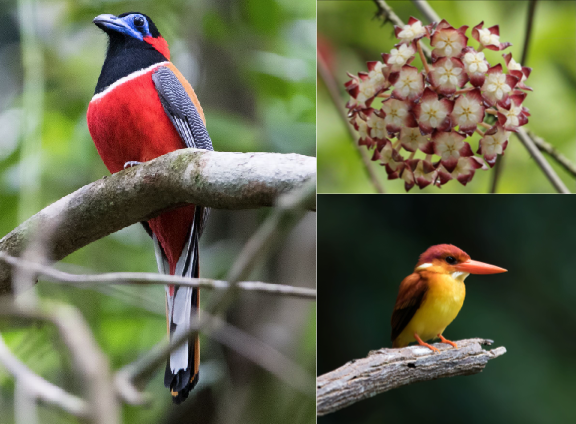
What are the impacts of tropical deforestation on biodiversity? To assess this, case studies are needed of tropical regions that have both a history of substantial deforestation and reliable biodiversity data. Singapore was almost entirely forested two hundred years ago but today less than 1% of the original primary forest remains today, with an additional ~20% of the landscape covered in lower quality secondary forest. Singapore also has an exceptionally detailed biodiversity record. Many species have gone extinct from Singapore, from the majestic tiger, the last of which was shot in the 1930s, to the humble epiphyte Hoya finlaysonii, which was last seen in 1837.
We compiled a comprehensive dataset of biodiversity in Singapore, comprising more than 50,000 individual records and representing more than 3,000 species and ten major taxonomic groups (mammals, birds, reptiles, amphibians, freshwater fishes, butterflies, bees, phasmids, decapod crustaceans, and plants). We developed novel statistical methods that account for “dark extinctions”, i.e., extinctions of undiscovered species, and estimated that 37% of Singapore’s species have gone extinct over the last two centuries. We extrapolated Singapore’s historical experience to a future scenario for the whole of Southeast Asia and estimated that around 18% of species would be lost regionally by 2100.
Our extinction estimates for both Singapore and future Southeast Asia are a factor of two lower than previous estimates, which we attribute to our improved statistical methods. However, extinctions in Singapore have been concentrated among charismatic species, including large mammals, forest-dependent birds, butterflies, and orchids. Thus, we speculate that if deforestation continues across the region, Southeast Asia may come to resemble a “tropical Europe”, where a large majority of species persist in a human-dominated landscape, but where many of the most charismatic species are absent. We recommend that future tropical conservation efforts focus on charismatic species such as tigers, elephants, rhinoceroses and orangutans, in line with the classic umbrella species approach.
The paper has just been published in PNAS. It represents the culmination of a decade of work by many people to assemble the comprehensive database of Singapore biodiversity records and develop the novel statistical methods needed to account for dark extinctions.
Several news outlets have reported on our work, including Mongabay, the Straits Times (see also this accompanying feature), and 联合早报 (Lianhe Zaobao).
Fanhua successfully defends her PhD
Kong Fanhua, who has been a visiting student in our lab for the past two years, recently successfully defended her PhD at her home institution, East China Normal University, where she is advised by He Fangliang. The title of her thesis was “Effects of the competition–colonisation trade-off on species coexistence in forest plant communities”. During her time in our lab, she successfully published a chapter from thesis on neighbourhood diversity of pioneer versus shade-tolerant trees in Baishanzu Nature Reserve in China (see here). She also has in preparation a manuscript about tree diversity in gaps and non-gaps in the Barro Colorado Island forest in Panama. Congratulations, Fanhua!

Tak’s new paper on a model of cyclic dengue dynamics published in the Bulletin of Mathematical Biology
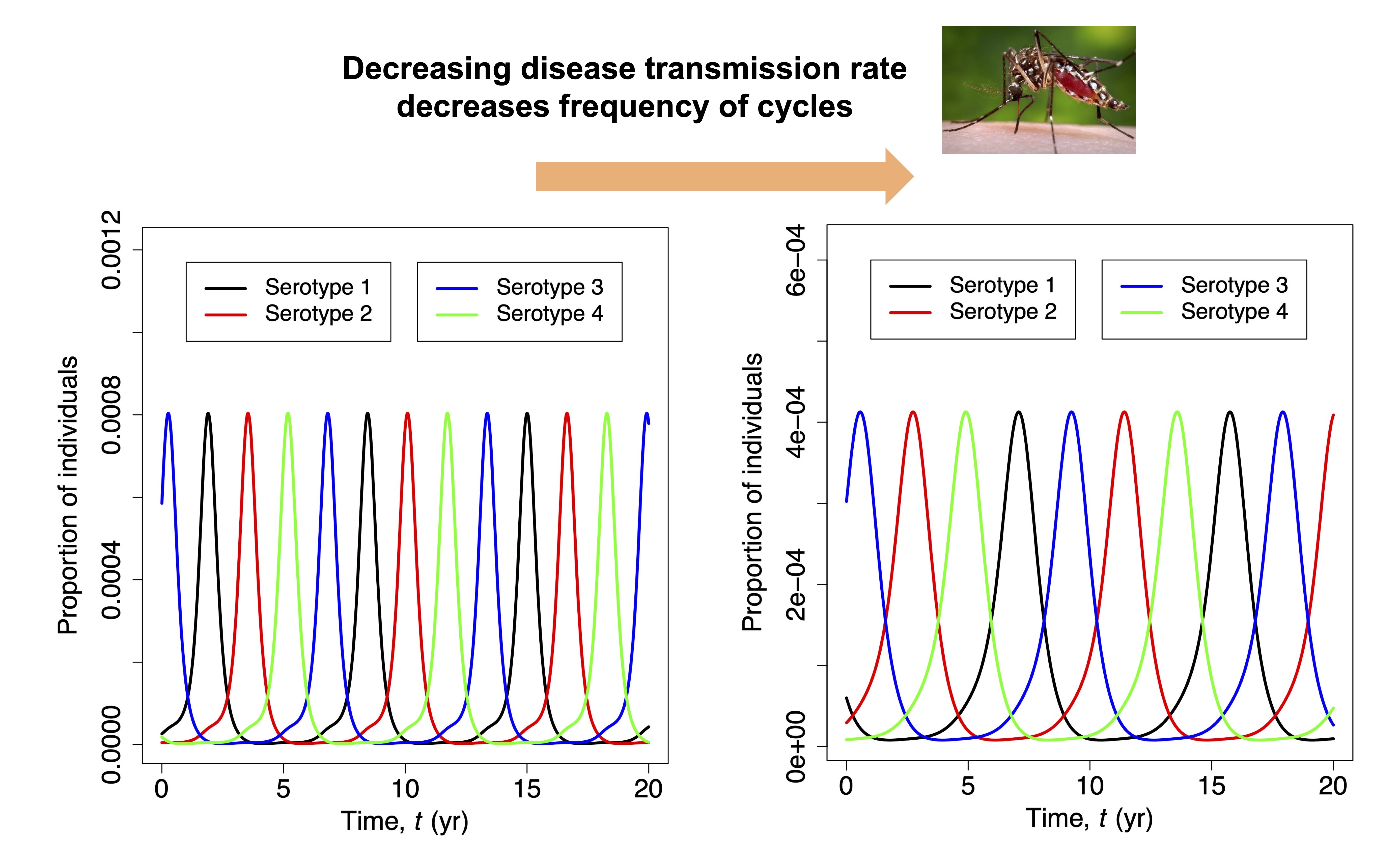
Dengue is a mosquito-borne virus that infects hundreds of millions of people every year, mainly in tropical countries. Dengue occurs as four different variants (serotypes) whose frequencies exhibit cyclic behaviour, but the mechanisms underlying these cycles are incompletely understood. A new study in the Bulletin of Mathematical Biology by Tak, Ryan and Hannah Clapham from the School of Public Health sheds new light on this by analysing a mathematical model describing the epidemiology of multiple serotypes of dengue infecting a host population. We found that after infection of a host by one serotype and subsequent recovery, a temporary period of immunity to infection by other serotypes creates a time-lag in between infections and thereby generates asynchronous cycles of the different serotypes. Without such temporary cross-immunity, there can only be synchronous cycles.
We also explored conditions that increase the frequency of the asynchronous cycles, when such cycles occur. The frequency increases with the disease transmission rate because this leads to susceptible hosts being infected at a faster rate and hence more rapid formation of epidemics. Thus, management measures aimed at decreasing the disease transmission rate, such as fogging to eliminate mosquitoes, can reduce the frequency of epidemics. In addition, the frequency of asynchronous cycles increases with the birth rate of the host population, which introduces susceptible newborn individuals into the population at a greater rate and hence results in more rapid formation of epidemics. Thus, countries with higher birth rates are expected to exhibit faster cycling of dengue serotypes.
Fung, T., H. E. Clapham, and R. A. Chisholm. 2023. Temporary cross-immunity as a plausible driver of asynchronous cycles of dengue serotypes. Bulletin of Mathematical Biology 85:124