The Ecological Society of America (ESA) has awarded Lynette and Ryan the George Mercer Award for their paper testing theories of community assembly using an experiment on intertidal communities in Singapore (Loke & Chisholm 2023). The George Mercer Award was established in 1948 and is given annually for an outstanding ecological research paper published in the last two years whose lead author is under 40. The ESA announcement wrote, “Deftly integrating field experiments with clear hypotheses and mathematical modeling, this study provides novel insights into an ecological question that has been debated for decades. The results of the paper advance our understanding of the forces structuring ecological communities, and the authors combine theory and empirical evidence in a creative and exceptionally well-written way.”
Lynette has collaborated with our lab on several projects in recent years. She moved to the University of Melbourne last year to start a spatial and community ecology lab.
Professor David Waxman, from Fudan University, just completed a two-week visit to our lab. David is a mathematical biologist who works on population genetics and evolution. During his visit, he engaged in productive and stimulating discussions with lab members, and he delivered a departmental seminar about a new multiallelic selection model he has been developing.
Co-operation is pervasive in human societies, but the evolutionary origins of co-operation are still incompletely understood. One prominent hypothesis for explaining co-operation is kin selection, whereby individuals accrue fitness benefits by helping close relatives who share many of their genes. Evolutionary game theory has been used to study the evolution of co-operation and kin selection, but until now it has been technically challenging to analyse scenarios where the benefits scale nonlinearly with the number of co-operators, which can occur, e.g., when there are economies of scale in a group activity such as a hunt.
In a new paper led by Nadiah Kristensen, we present a new mathematical method for rigorously accounting for relatedness in evolutionary models with an arbitrary number of players and an arbitrary number of discrete strategies, e.g., co-operators and defectors. We demonstrate the method with an application to a game in which the benefit to individuals rises sharply once some threshold number of co-operators is passed, representing, e.g., a successful hunt. In addition to unconditional co-operators and unconditional defectors, we allow a cognitively advanced strategy: co-ordinated co-operators, who conduct a lottery prior to each game to ensure that the threshold number of co-operators is attained. We find that co-ordinated co-operation is favoured by kin selection. However, if we allow homophily to decline, as happened over the course of human evolution, co-ordinated co-operators can be invaded by another cognitively advanced strategy, the liar, who participates in lotteries but does not follow through on commitments to co-operate. For coordinated cooperation to resist invasion by liars, either some level of homophily must be maintained, or following through on the agreement after a lottery must be in players’ self interest.
Our approach will be broadly useful for exploring the evolution of co-operation in other scenarios involving cognitively advanced strategies that arise from leaps of insight into how the game works. Such scenarios could include, for example, the evolution of punishment and enforcement institutions.
Nadiah was until last year a Research Fellow in our lab, and she is now working at the University of Queensland. This paper was part of an ongoing collaboration with Hisashi Ohtsuki at The Graduate University for Advanced Studies in Japan.
The species–area relationship (SAR) describes how the number of species increases with the area of observation. Classically, the SAR is thought to have three phases: a steep sampling phase at small scales; a shallower power-law phase at intermediate scales; and another a steep phase at very large scales where increases in the logarithm of area reveal new biogeographic realms. More recently, we predicted the presence of a typically hidden fourth SAR phase, sandwiched between the first two classic phases. This elusive SAR phase should be nearly flat, and we call it the niche-structured phase, because within it the number of species is roughly equal to the number of niches. We predicted that the niche-structured SAR phase should be exposed only in unusual scenarios where dispersal or large-scale species richness or both are very low.
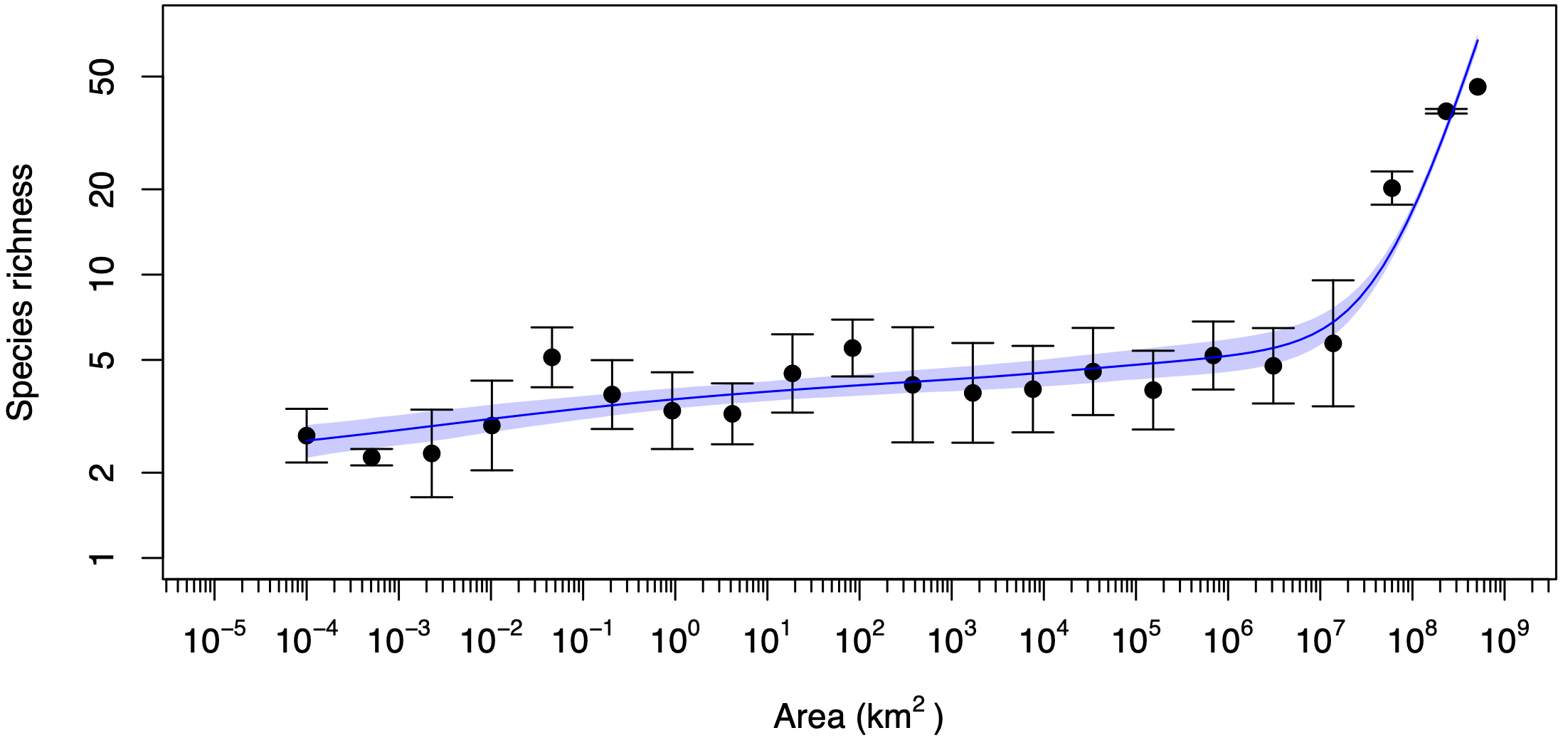
In a new paper, just published in Oikos, we discover the elusive fourth SAR phase in a global mangrove dataset. Mangroves are a species-poor group, comprising only around 70 species despite having a global distribution. We found that mangrove species richness exhibits very little change from scales of 100 m2 to 1 million km2, in contrast to a typical power-law SAR, which would exhibit about a factor of 300 increase over this range of scales. Crucially, the species richness did not just collapse to one, which would be a trivial result, but was consistently maintained at about two or three, which we interpret as a measure of the typical number of tidal niches available in a mangrove ecosystem.
This work grew out of the Honours project of NUS undergraduate student Nicholas Fong, and involved a collaboration with mangrove experts Dan Friess and Andre Rovai.
A mangrove tree (Rhizophora spp.) in Peninsular Malaysia. Photo credit: Dan FriessThe species–area relationship for mangroves in the Indo–West Pacific, exhibiting an almost flat phase that spans ten orders of magnitude of area.
Barro Colorado Island (BCI) in central Panama was created when the surrounding forest was flooded in 1914 to create the Panama Canal. The island became a reserve in 1923 and its 15 km2 of tropical forest have been the subject of intensive study ever since. To commemorate 100 years of research on the island, Helene Muller-Landau and Joe Wright, of the Smithsonian Tropical Research Institute, have edited a new two-volume book titled “The First 100 Years of Research on Barro Colorado: Plant and Ecosystem Science“. Ryan has contributed a chapter to this book titled “The Forests of Barro Colorado Island the Neutral Theory of Biodiversity“, which chronicles the history of the neutral theory of biodiversity and how this history has been interwoven with field research at BCI.
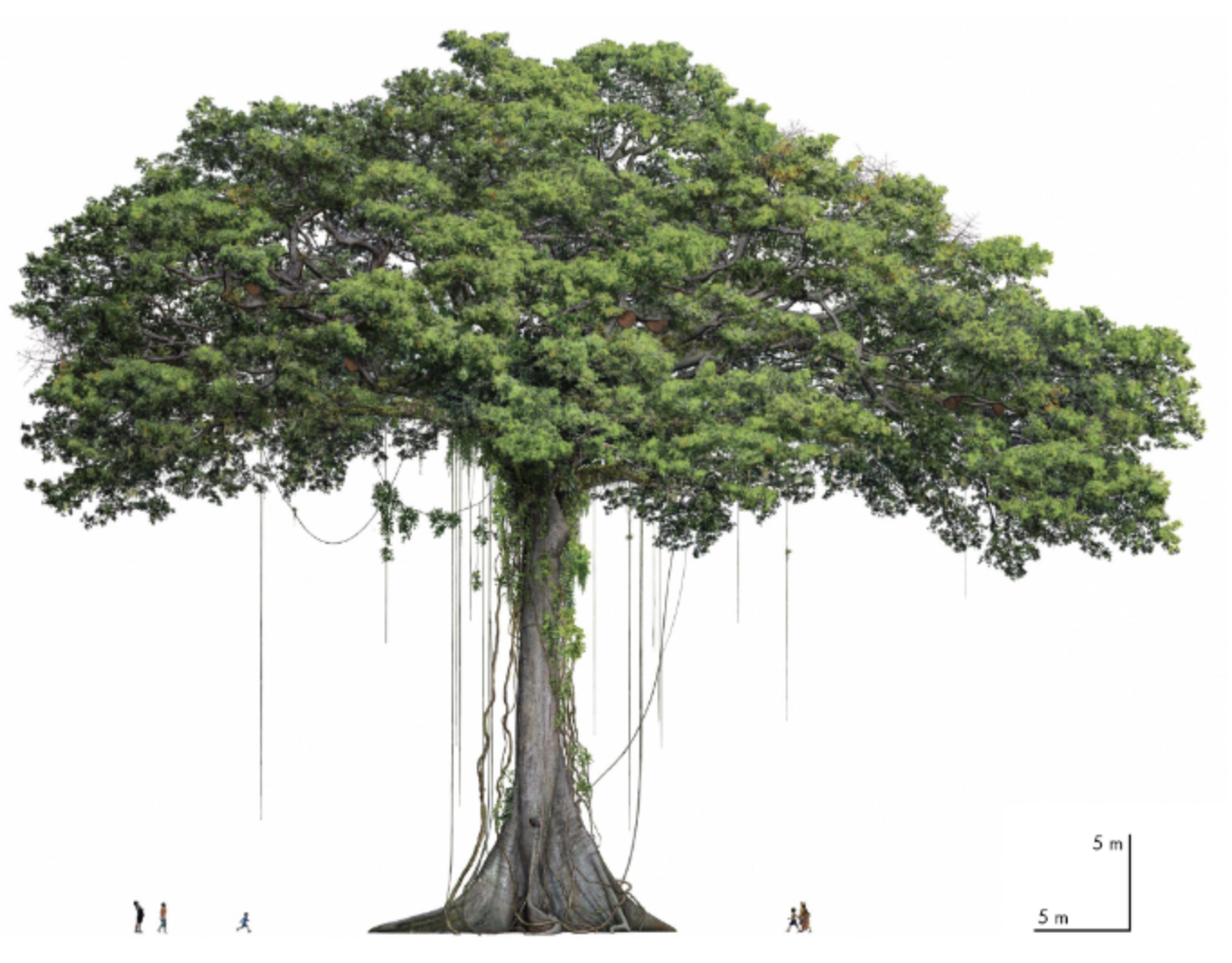
Cover art from the book, depicting BCI’s “big tree”, an individual of the species Ceiba pentandra that died in 2013.
We collated forest inventory data at three different scales—local, regional and global—and found signals of synchrony up to scales well beyond 100 km. For the Pasoh and Lambir forests, in particular, there was clear evidence of synchrony for larger trees (greater than 10 cm diameter) although not for smaller trees. A technical challenge in our analyses was developing statistical methods to produce an aggregate estimate of synchrony for each pair of forest sites while accounting for the noise inherent in datasets with large numbers of rare species. Although existing methods are available to estimate synchrony for individual species, these were not appropriate for our forest data because of the short duration of our datasets (a few decades at most) relative to the typical tree generation time. Our novel methods make use of copulas, which are used to model multivariate statistical phenomena in quantitative finance.
We attributed the observed synchrony in tree population dynamics to synchronised environmental drivers, such as climate, although we lacked the statistical power to identify particular drivers. The observed synchrony suggests greater risk of extinction for tree species that are more spatially constrained, especially those with range dimensions less than ~100 km. On the other hand, species with larger ranges may be buffered from extinction by the lack of synchrony in their population dynamics across space.
Forest tree population dynamics are synchronised across space, with synchrony detectable even beyond 100 km. Dark blue, light blue and green curves indicate the results of local, regional and global analyses. Line types indicate the spatial grain of each analysis: synchrony is lower for smaller spatial grains because of immigration.
Kong Fanhua was a visiting PhD student in our lab in 2022–2023, during which time she worked on a study of tropical forest gap diversity that has just been published in Ecology. Forest gaps are created when large trees fall. Gaps experience greater below-canopy light levels than non-gaps and thus see increased recruitment of young trees. It has long been hypothesised that forest gaps have higher tree diversity than non-gaps, but surprisingly until now there has not been a satisfactory statistical test of the hypothesis. We focussed our analyses on the 50 ha forest plot on Barro Colorado Island in Panama, leveraging regular forest census data going back decades, as well as canopy-height survey data that facilitated gap identification.
Our main finding was that although the average number of tree species in any given gap was only slightly higher than a same-sized non-gap site, collections of gaps had many more species than similar collections of non-gaps. We identified 124 newly formed gaps (each 25 m2) in 2003 and when these were seven years old they contained 149 tree species in total compared to only 109 tree species in a comparable collection of non-gap sites. Qualitatively similar, but somewhat weaker, results were observed when the gaps were two and 12 years old. These notable differences between gaps and non-gaps strongly indicate an important role for gaps in the maintenance of plot-level tree diversity.
Sean Pang, who completed his PhD in our lab in 2022, has successfully published a chapter from this thesis about conserving Southeast Asian tree species in the face of both climate and land-use change. He modelled nearly 1,500 tree species distributions and explored how they would fare under four future climate-change scenarios involving different assumptions about human mitigation efforts. As expected, the tree species overall fared best under the most sustainable climate pathway (SSP1-2.6), but surprisingly the intermediate climate pathways (SSP2-4.5 and SSP3-7.0) were worse for biodiversity than the least-sustainable climate pathway (SSP5-8.5). The main reason was that the intermediate climate pathways involved greater land-use change for biofuel production to support a partial transition away from fossil fuels. The results demonstrate how halfway efforts to prevent climate change can potentially have detrimental effects on biodiversity. The paper is just out in the journal Nature Sustainability.
From 5th to 9th August 2024, Sankar attended the 10th World Congress of Herpetology, held in Kuching, Sarawak. This is a meeting of global herpetologists held every four years. Sankar presented a poster on his work tracking squamate (lizard and snake) extirpations in Singapore using the SEUX and MODGEE models developed in our lab.
The SEUX model takes in the first and last years of detection for the species in a group and estimates the rates of known extinctions and dark extinctions (i.e., extinction prior to discovery) that occur within that group. The MODGEE model takes advantage of the entire detection time series and can additionally estimate the extinction probability of individual species and the time of extirpation. A recent comprehensive compilation of herpetofaunal records in Singapore has made it possible to use MODGEE to obtain these estimates for squamates (snakes and lizards). The resulting assessments of which species are extinct can be valuable in planning species reintroductions in the future.
The conference was well attended (~1500 delegates) and there were many opportunities to engage and network with other herpetologists from around the world working on conservation translocations, capture-mark-recapture monitoring and population viability analysis.
At the end of the conference, Sankar was awarded the best poster in the multi-taxa category. Congratulations, Sankar!
In the first week of July, Tak attended the Joint Annual Meeting of the Korean Society for Mathematical Biology and the Society for Mathematical Biology, held in Seoul. During the conference, he presented some new results on deriving probability distributions of extinction time for a population model with a growth rate that varies stochastically due to environmental fluctuations. This is an important topic for conservation because many species are in danger of extinction and it is unclear how environmental changes over time affect their extinction risk.
Specifically, the environmental fluctuations in the model are assumed to follow a random process that is called 1/f noise, following empirical evidence that many environmental variables in reality follow such a random process. Analyses of the model show that the mean extinction time should increase with the autocorrelation time of environmental fluctuations, because of non-linear averaging of the proportional growth rate over different sets of environmental conditions (technically, this is an application of Jensen’s inequality to the proportional growth rate). Because environmental variables in marine ecosystems tend to have longer autocorrelation times than in terrestrial systems, our model predicts that the mean extinction time would generally be greater for marine versus terrestrial populations, provided that the populations are comparable in other aspects of their biology.
In addition, Tak engaged with numerous other researchers and exchanged thoughts on different areas in mathematical biology, including but not limited to ecology and evolution. In particular, he met up with Nao Takashina from the University of Tokyo, who collaborated with Tak and Ryan on a recent paper, published in the Journal of Ecology, on mechanistic partitioning of species richness in tropical forest tree communities.





 Chisholm Lab
