Last week, Hisashi Ohtsuki from SOKENDAI (the Graduate University for Advanced Studies) in Japan visited the lab. Hisashi studies evolutionary game theory and has been collaborating with us over the past few years on related problems, resulting in a publication led by Nadiah Kristensen last year. During his visit, Hisashi gave the departmental colloquium, engaged with students and staff in the lab and the department more broadly, and worked on our ongoing collaborative projects.
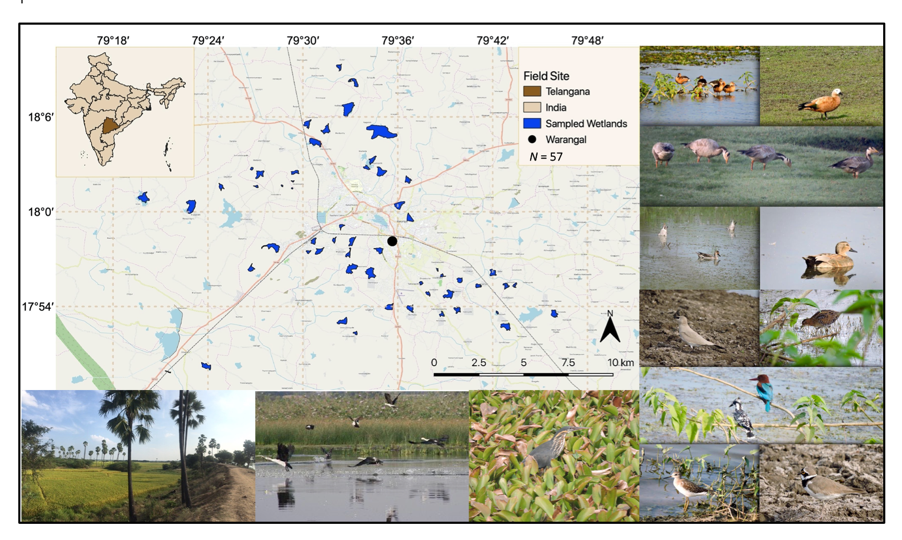
As part of her PhD research in our lab, Deepthi Chimalakonda conducted six censuses of water birds over four years at 57 wetlands in the Warangal district of Telangana state in India (see map below), with the aim of understanding the forces that structure these bird communities. These wetlands are artificial habitats created by humans for irrigation and other purposes, but they are also valuable habitat for wildlife. Such artificial ecological communities are becoming increasingly common around the world as humans continue to modify natural environments, and it is crucial to understand their potential role in conserving biodiversity.
In her wetland data, Deepthi found that the wetland bird communities were highly dynamic, with substantial turnover in the species present from one census to the next. There was also substantial spatial turnover between neighbouring wetlands, even at distances of just 1 km. These results are consistent with the hypothesis that each wetland’s bird community is at a dynamic equilibrium with bird diversity arising from a balance between immigration and local extinction, as in classic island biogeography. The observed species abundance distributions and species–area relationships were also consistent with this hypothesis. Deepthi’s work has just been published in Diversity and Distributions. Deepthi is currently a post-doctoral research fellow at Nanyang Technology University in Singapore.
Last week Ryan attended a Gordon Research Conference on predictive ecology, held at Stonehill College just outside of Boston. The conference was motivated by a need for more quantitative predictions in ecology, in order to test our understanding of ecological systems and to aid conservation. Speakers came from a diverse array of disciplines, leading to many creative discussions. Ryan spoke about our lab’s work on testing predictions of mechanistic biodiversity models against data, including our recent experimental paper on intertidal communities. Several speakers discussed the recent success of machine learning at predicting ecological systems—surprisingly, in many cases these predictions are better than those based on traditional mechanistic models. Also of interest was the NEON Ecological Forecast Challenge, which encourages researchers to submit forecasts for a range of variables (e.g., beetle abundance, bird counts, and canopy leaf area) from the National Ecological Observatory Network (NEON), a network of 81 monitoring sites across the United States that began operation in 2019.
Ames Estate at Stonehill College. Photo Credit: Kenneth C. Zirkel (CC BY-SA 4.0)
What determines the number of species that occur together in a given ecological community? One view is that species richness is driven mainly by characteristics of the local site, such as resource availability and habitat diversity. This is the niche perspective. Another view is that species richness is driven mainly by immigration from a larger region. This is the dispersal perspective. A long-standing goal of ecology is to reconcile these two perspectives. A classic unified theory predicts that dispersal assembly is observed only when immigration to a system is very low, and that niche assembly is observed in most other situations. A novel unified theory, developed by our lab (see here and here), predicts just the opposite: that niche assembly is observed only when immigration is very low, with dispersal assembly prevailing otherwise.
In a paper led by Lynette Loke and just published in Nature, we present the results of an experiment designed to test these two unified theories by systematically varying the rate of immigration and observing the response of species richness. Our focal system was intertidal animal communities on artificial seawalls in Singapore. The communities comprise crustaceans, gastropods, bivalves, tunicates and other creatures (the photo below shows lightning dove shells, Pictocolumbella ocellata). Each experimental unit was a concrete tile overlain by a stainless steel cage with polycarbonate sheet panels, into which we punched variable numbers of holes to allow different immigration rates across treatments.
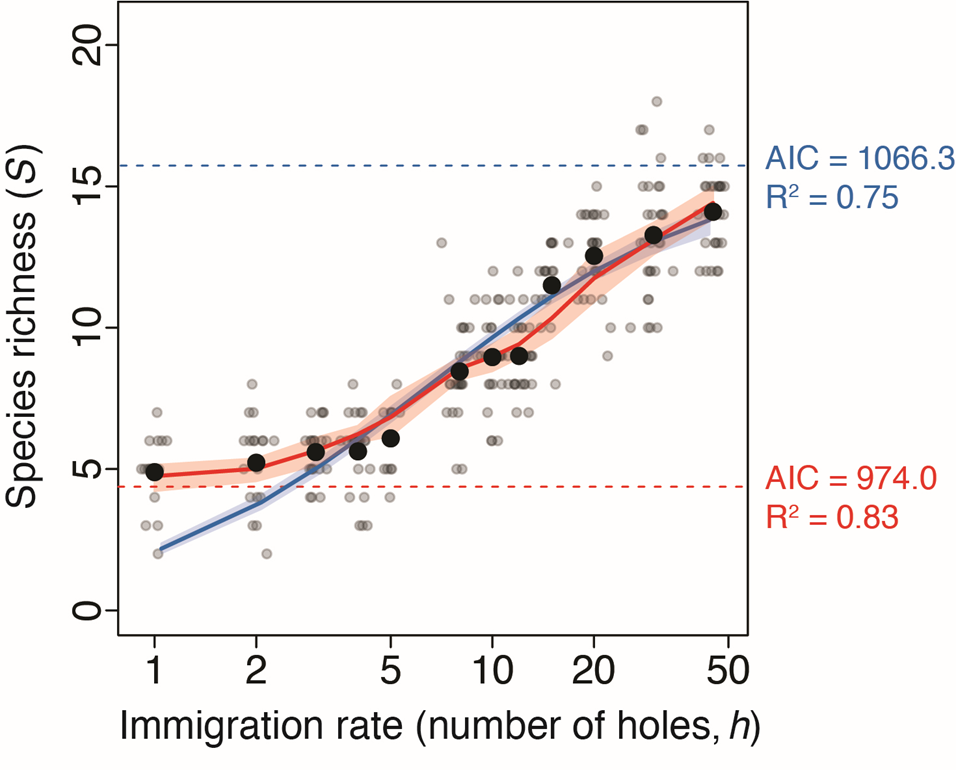
The results were consistent with the novel unified theory. The number of species was roughly constant, at around five, for low-immigration treatments with one to five holes, but then began to increase substantially with the addition of further holes (see graph below). This implies that roughly five animal species can coexist via niche assembly in these seawall communities in the absence of substantial immigration, but in practical settings the communities will usually be in a dispersal-assembly regime with many more than five species, because natural immigration is higher than even in our highest-immigration experimental treatment. If these results can be generalised to other systems, it would follow that the species diversity we see small-scale ecological communities in the natural world is largely due to dispersal assembly rather than niche assembly.
This project is the most recent in a series of collaborations between Lynette and our lab (see here and here). Lynette is currently a post-doctoral researcher Macquarie University in Sydney. The experimental work for this project involved her going out alone into the field for a few days every fortnight for 12 months and navigating various challenges including pandemic social-distancing restrictions. The journal has also published a Research Briefing about the work.
The relationship of species richness to immigration rate in our seawall communities is close to flat for low immigration rates, suggesting that niche assembly dominates here, but strongly increasing above a threshold immigration rate, indicating that dispersal assembly dominates at high immigration rates. The blue curve shows the fit of the classic unified theory (which predicts saturation of species richness under high immigration at the blue dashed line; hypothesis 1), and the red curve shows the fit of the new unified theory (which predicts a lower bound on species richness under low immigration at the red dashed line; hypothesis 2).
Nadiah is currently on a ten-week visit to Hisashi Ohtsuki’s lab at SOKENDAI (The Graduate University for Advanced Studies) in Japan. We have been collaborating with Hisashi over the past couple of years exploring questions related to the evolution of co-operation using a novel mathematical framework that accounts for higher-order genetic associations. This work resulted in a publication a few months ago. During Nadiah’s visit to Japan, she and Hisashi have been finalising work extending this mathematical framework to evolutionary games with many different strategies (rather than just two), and exploring new ideas related to homophilic group formation. This week she gave a presentation at SOKENDAI about our lab’s work on this and other topics.
Forests are a massive store of carbon and also contain a large fraction of the earth’s species. Conserving forests is thus essential for mitigating both climate change and biodiversity loss. But how synergistic are these goals? Do forests that sequester more carbon also have high biodiversity? If so, that suggests we can get more bang for our conservation buck by protecting such forests. If not, we may need largely complementary approaches to carbon conservation and biodiversity conservation. The answer depends on the form of the biodiversity–productivity relationship.
In a just-published review paper by Ryan and Tanvi Dutta Gupta, an undergraduate student at Stanford University who has been an occasional visitor to our lab, we assess current knowledge about the forest biodiversity–productivity relationship and discuss its implications for conservation. We find that the relationship is generally positive: forests with more tree species tend to be more productive, and thus sequester carbon more rapidly. However, there are several important caveats to this that may limit the relevance to conservation. Firstly, even though on average more species means more productivity, in many cases the most-productive forest stands are monocultures of particular fast-growing species, such as eucalpyts. Secondly, the productivity gains of having more than ten species are hard to perceive. Thirdly, the relationship between biodiversity and productivity may not be causal, but driven by some third variable, such as tree density. Fourthly, the relationship varies markedly across spatial scales and may not be strongly positive at scales relevant to conservation. Lastly, current methods for estimating productivity in forests have large errors associated with them. Clearly, more work is needed before we can confidently quantify the carbon benefits of protecting or planting diverse forests.
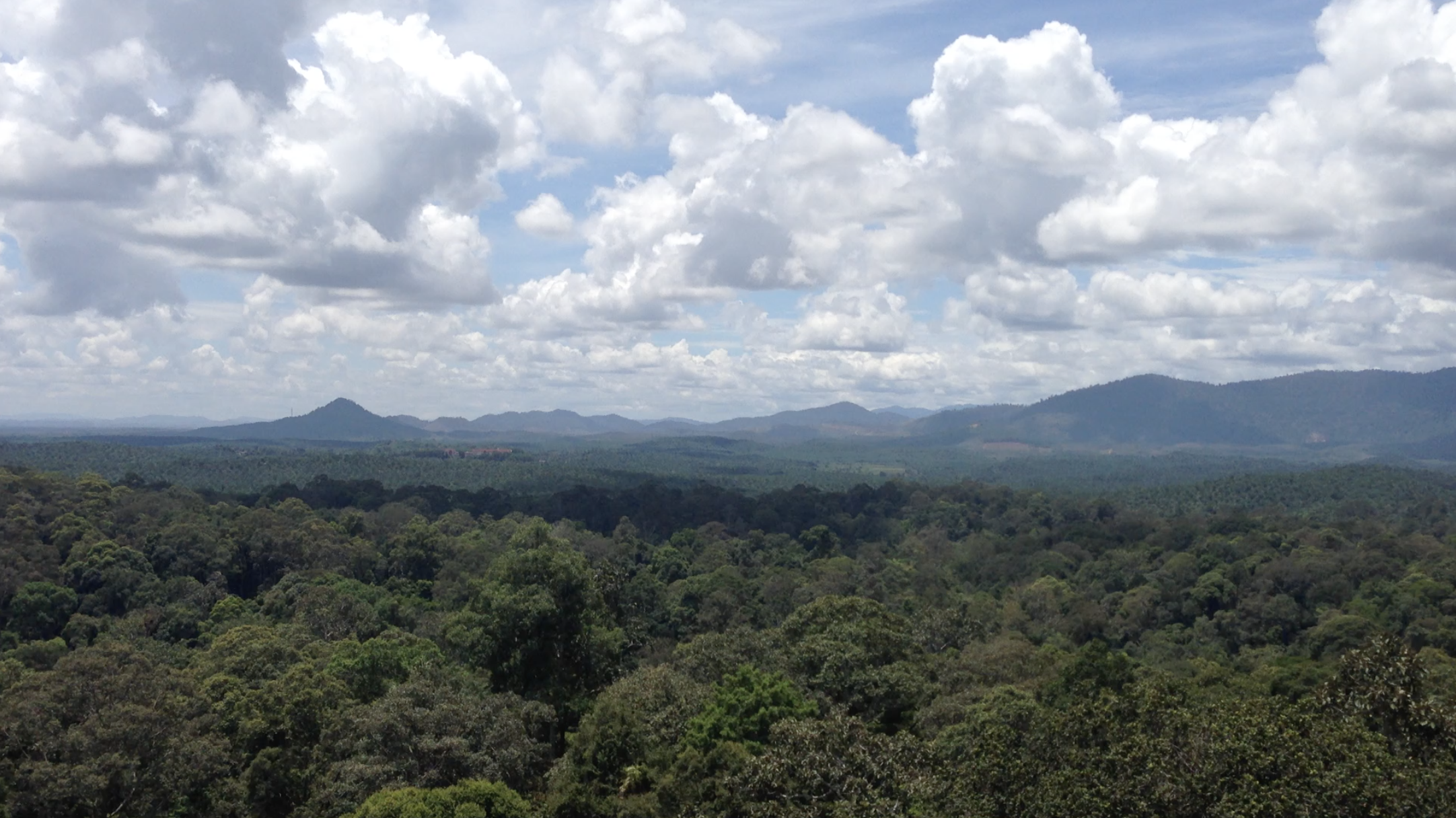
Pasoh Forest Reserve, Malaysia, has very high tree diversity. Such forests also tend to have higher productivity, but the strength of this relationship depends strongly on factors such as the scale of observation and whether confounding variables are controlled for.
In a new paper led by Martin Trappe we present density functional theory for ecology (DFTe)—a new framework for ecological modelling. Ecology currently has detailed mechanistic theories that can describe the interaction of a few interacting species at small scales, and statistical theories that can describe the dynamics of large numbers of species at large scales. But a persistent challenge is to develop unified modelling approaches that can span a range of temporal and spatial scales.
In the new paper, we draw on density functional theory, which has found wide application to many-body problems in physics. We take density functional theory’s computational framework and apply it to ecology, demonstrating with several examples its potential power for predicting the outcome of ecological interactions. In essence, our DFTe takes data from simple systems (e.g., two-species competition), fits an energy functional to the data, and uses this to predict the outcomes of more complex systems (e.g., multi-species competition). The applications we present range from classic two-species algal competition experiments to microbial predator–prey systems to tropical forest tree communities. We believe that our DFTe can contribute to a more unified understanding of ecological systems.
Martin is a Senior Research Fellow in the Physics department; this project arose from his two-year 50% appointment in the Biological Sciences department a few years ago. The paper has just been published in Nature Communications.
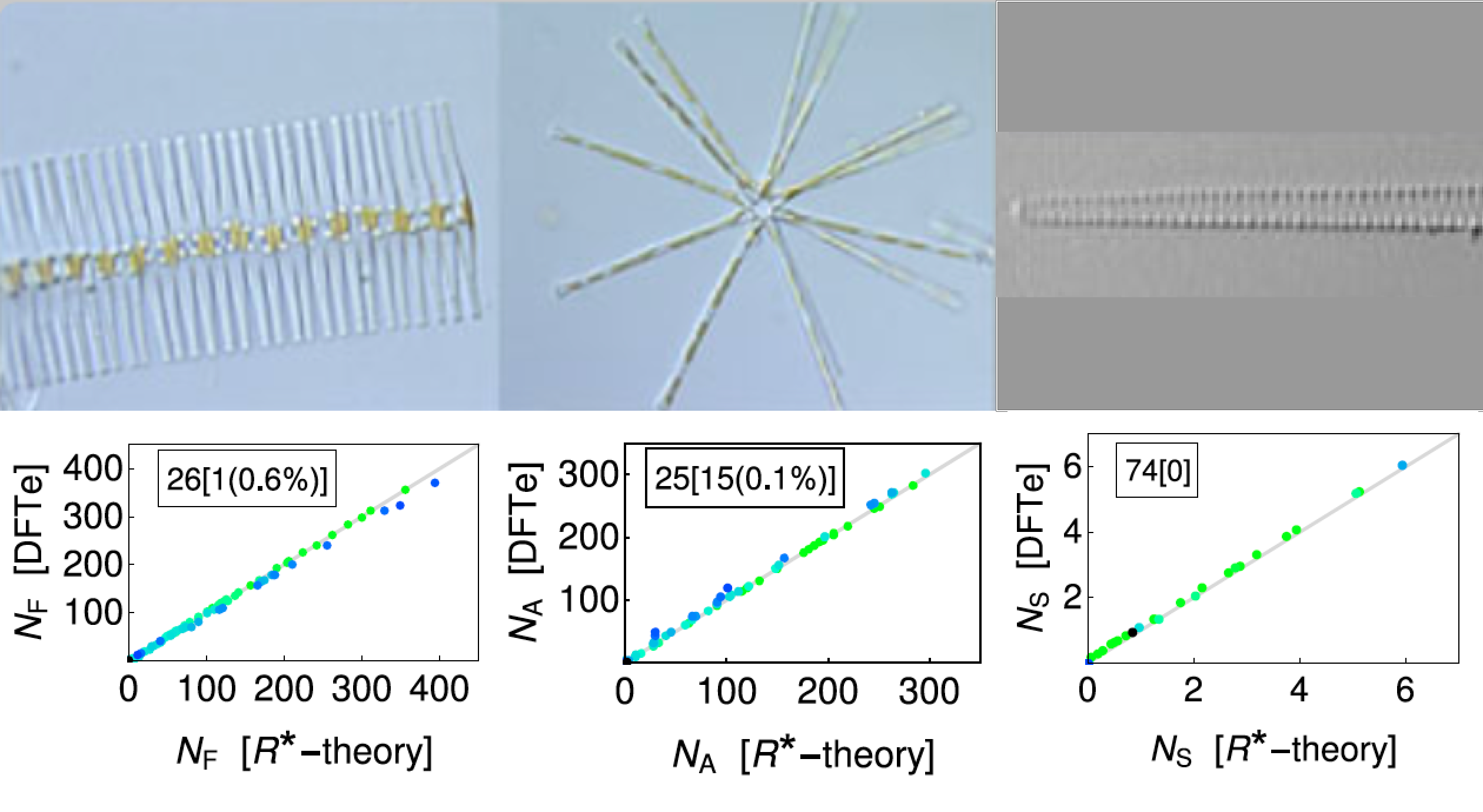
One of our case studies focussed on Tilman’s (1981, Ecology) classic algal experiments. Photos at top show some of the algal species concerned (photo credit: Jason Oyadomari for the first two images and Don Charles for the third). Graphs at bottom show predicted outcomes from a hypothetical experiment of four algal species competing for two resources (only results for three species are shown because the fourth always went extinct). Predicted algal abundances from our DFTe (vertical axes) were almost identical to those of Tilman’s R* theory (horizontal axes). Each point shows the results for one randomly chosen pair of values for the resource input rates (greener colours indicate points closer to the one-to-one line).
Ryan visited the University of Texas at Austin last week and gave the weekly seminar in the Department of Integrative Biology. He talked about our lab’s work on estimating historical extinctions in Singapore and on untangling the roles of dispersal assembly and niche assembly in ecological communities. He was hosted by Asst. Prof. Caroline Farrior, and enjoyed learning about her lab’s work on understanding the structure of plant communities using a combination of theoretical and empirical approaches.
He also visited the Department of Ecology and Evolutionary Biology at Princeton University, where he met with colleagues and presented our lab’s work at the Theoretical Ecology Lab Tea.
Kong Fanhua has been a visiting PhD student in our lab for the last year and her first paper has just been published in Forest Ecology and Management. The paper focuses on the Baishanzu 25 ha forest plot in China, which comprises subtropical forest with a mix of patches of different ages and management histories, and a mix of early-, mid- and late-successional tree species. Fanhua’s main result was that tree diversity is higher around early-successional trees, emphasising the importance in forest management of having a variety of species of different successional stages and a variety of stand ages.
Neutral biodiversity models make the simplifying assumption that all species are the same. These models have been used extensively over the last two decades to understand real biodiversity patterns. One failing of neutral models is that they predict species ages that are far too long. For example, for Amazon trees standard neutral models predict species ages that exceed the age of the angiosperms (~140 million years). In a new paper led by Tak, we explore a mechanism that can fix species ages in these models without breaking neutrality: allowing community size to change over time in a non-equilibrium situation. We develop new mathematical formulas for the species abundance distribution and species ages in a neutral model with changing community size. We show that if this model is parameterised to represent changes in the size of the Amazon since a meteor impact obliterated much of the vegetation 66 million years ago, it can produce species ages and a species abundance distribution that are both consistent with reality. The results suggest that a neutral explanation for Amazon tree diversity cannot be completely ruled out.
An artist’s impression of the meteor impact that largely obliterated Amazon vegetation 66 million years ago. Image credit: Creative Commons Zero license, and A Owen from Pixabay.