
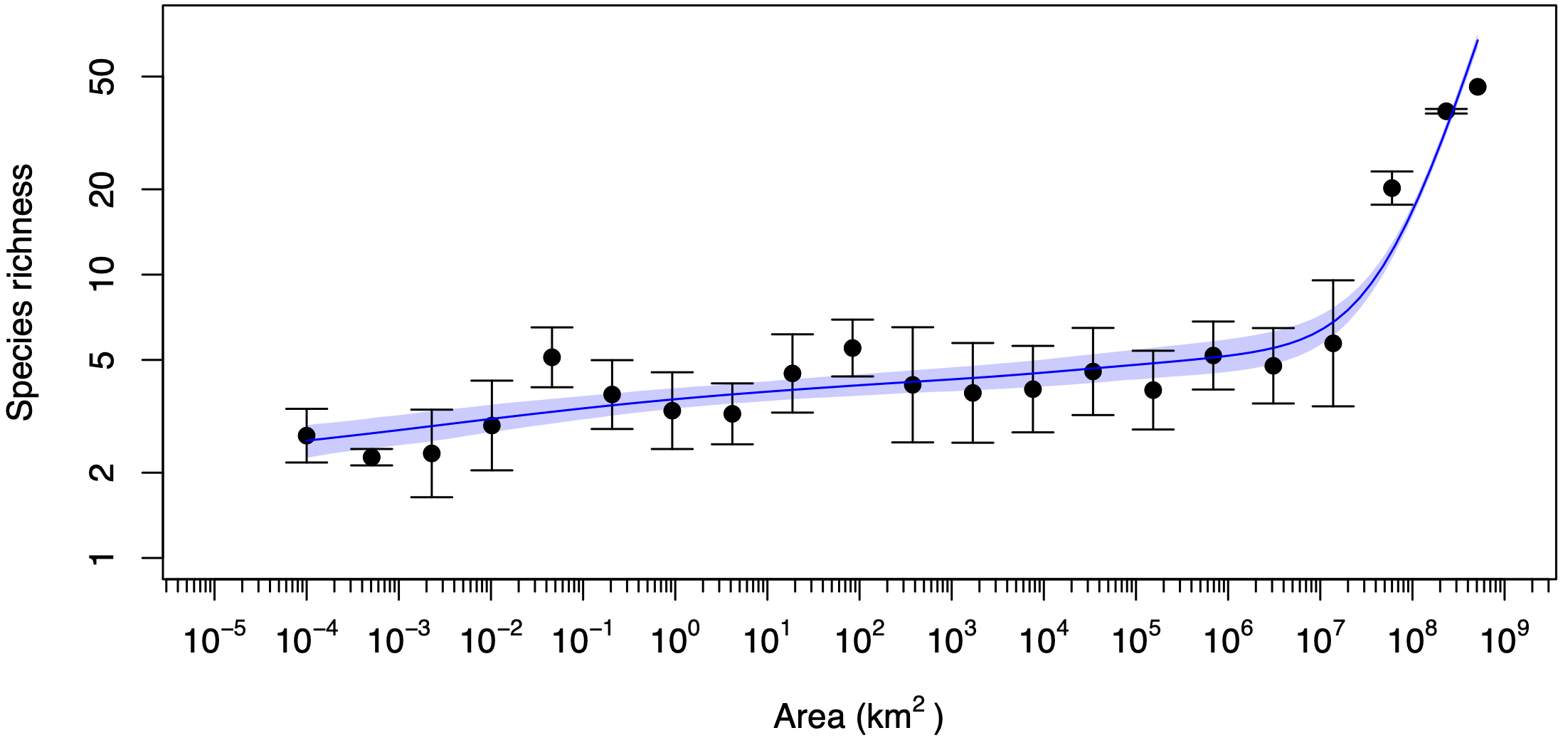
The species–area relationship (SAR) describes how the number of species increases with the area of observation. Classically, the SAR is thought to have three phases: a steep sampling phase at small scales; a shallower power-law phase at intermediate scales; and another a steep phase at very large scales where increases in the logarithm of area reveal new biogeographic realms. More recently, we predicted the presence of a typically hidden fourth SAR phase, sandwiched between the first two classic phases. This elusive SAR phase should be nearly flat, and we call it the niche-structured phase, because within it the number of species is roughly equal to the number of niches. We predicted that the niche-structured SAR phase should be exposed only in unusual scenarios where dispersal or large-scale species richness or both are very low.
In a new paper, just published in Oikos, we discover the elusive fourth SAR phase in a global mangrove dataset. Mangroves are a species-poor group, comprising only around 70 species despite having a global distribution. We found that mangrove species richness exhibits very little change from scales of 100 m2 to 1 million km2, in contrast to a typical power-law SAR, which would exhibit about a factor of 300 increase over this range of scales. Crucially, the species richness did not just collapse to one, which would be a trivial result, but was consistently maintained at about two or three, which we interpret as a measure of the typical number of tidal niches available in a mangrove ecosystem.
This work grew out of the Honours project of NUS undergraduate student Nicholas Fong, and involved a collaboration with mangrove experts Dan Friess and Andre Rovai.

 Chisholm Lab