
Dengue is a mosquito-borne virus that infects hundreds of millions of people every year, mainly in tropical countries. Dengue occurs as four different variants (serotypes) whose frequencies exhibit cyclic behaviour, but the mechanisms underlying these cycles are incompletely understood. A new study in the Bulletin of Mathematical Biology by Tak, Ryan and Hannah Clapham from the School of Public Health sheds new light on this by analysing a mathematical model describing the epidemiology of multiple serotypes of dengue infecting a host population. We found that after infection of a host by one serotype and subsequent recovery, a temporary period of immunity to infection by other serotypes creates a time-lag in between infections and thereby generates asynchronous cycles of the different serotypes. Without such temporary cross-immunity, there can only be synchronous cycles.
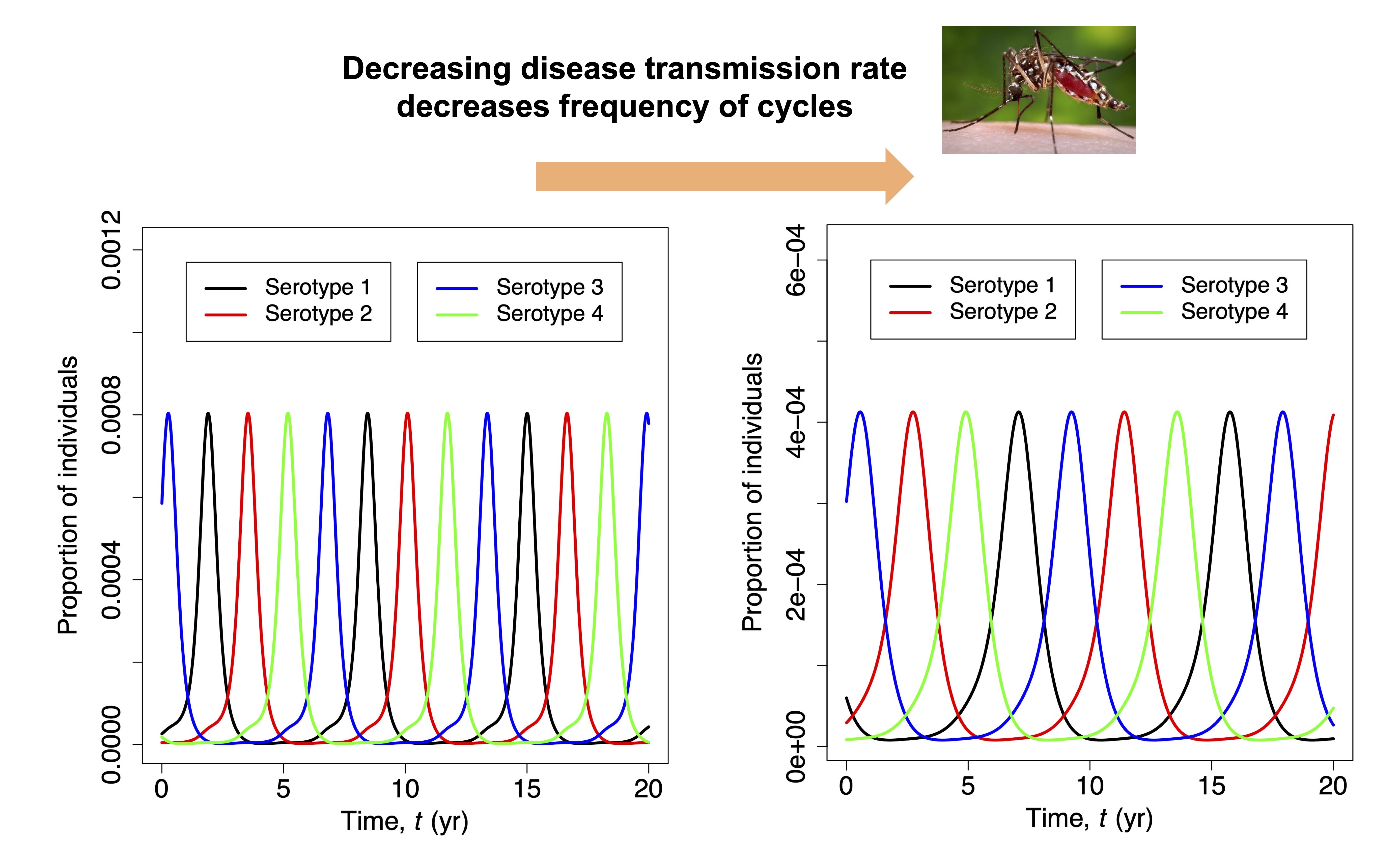
We also explored conditions that increase the frequency of the asynchronous cycles, when such cycles occur. The frequency increases with the disease transmission rate because this leads to susceptible hosts being infected at a faster rate and hence more rapid formation of epidemics. Thus, management measures aimed at decreasing the disease transmission rate, such as fogging to eliminate mosquitoes, can reduce the frequency of epidemics. In addition, the frequency of asynchronous cycles increases with the birth rate of the host population, which introduces susceptible newborn individuals into the population at a greater rate and hence results in more rapid formation of epidemics. Thus, countries with higher birth rates are expected to exhibit faster cycling of dengue serotypes.
Fung, T., H. E. Clapham, and R. A. Chisholm. 2023. Temporary cross-immunity as a plausible driver of asynchronous cycles of dengue serotypes. Bulletin of Mathematical Biology 85:124
 Chisholm Lab