
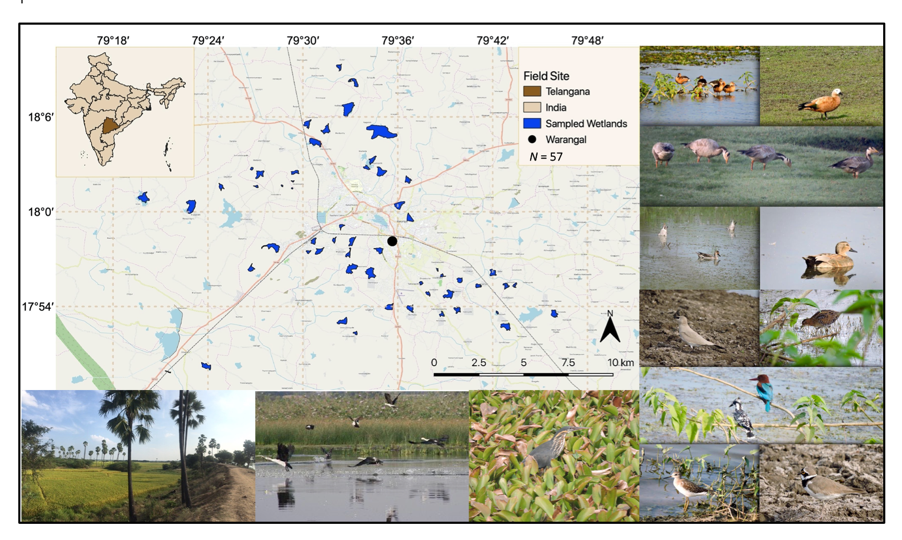
As part of her PhD research in our lab, Deepthi Chimalakonda conducted six censuses of water birds over four years at 57 wetlands in the Warangal district of Telangana state in India (see map below), with the aim of understanding the forces that structure these bird communities. These wetlands are artificial habitats created by humans for irrigation and other purposes, but they are also valuable habitat for wildlife. Such artificial ecological communities are becoming increasingly common around the world as humans continue to modify natural environments, and it is crucial to understand their potential role in conserving biodiversity.
In her wetland data, Deepthi found that the wetland bird communities were highly dynamic, with substantial turnover in the species present from one census to the next. There was also substantial spatial turnover between neighbouring wetlands, even at distances of just 1 km. These results are consistent with the hypothesis that each wetland’s bird community is at a dynamic equilibrium with bird diversity arising from a balance between immigration and local extinction, as in classic island biogeography. The observed species abundance distributions and species–area relationships were also consistent with this hypothesis. Deepthi’s work has just been published in Diversity and Distributions. Deepthi is currently a post-doctoral research fellow at Nanyang Technology University in Singapore.
 Chisholm Lab